22 Ways to Style a Sage Green and Grey Bedroom for Restful Sleep
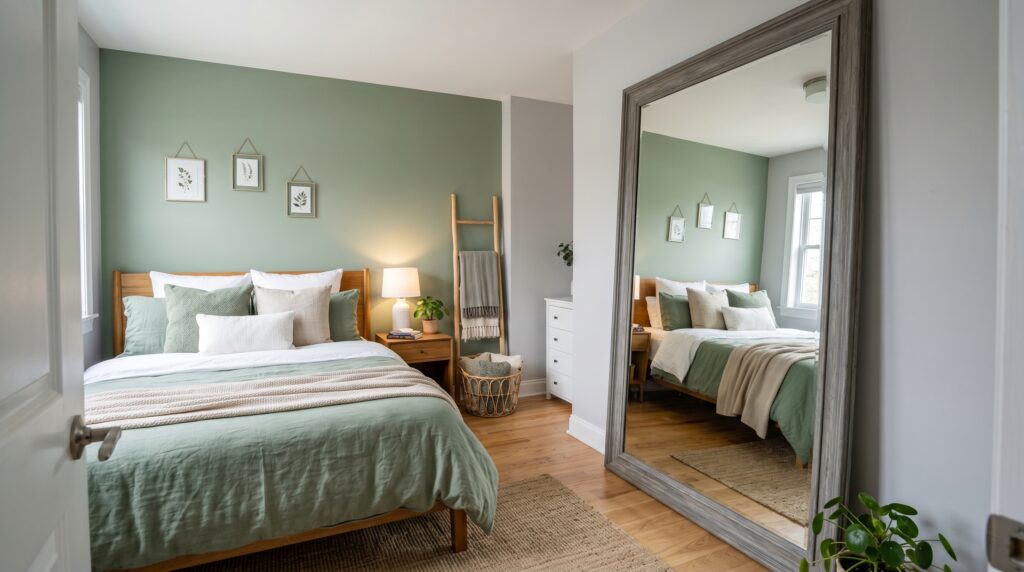
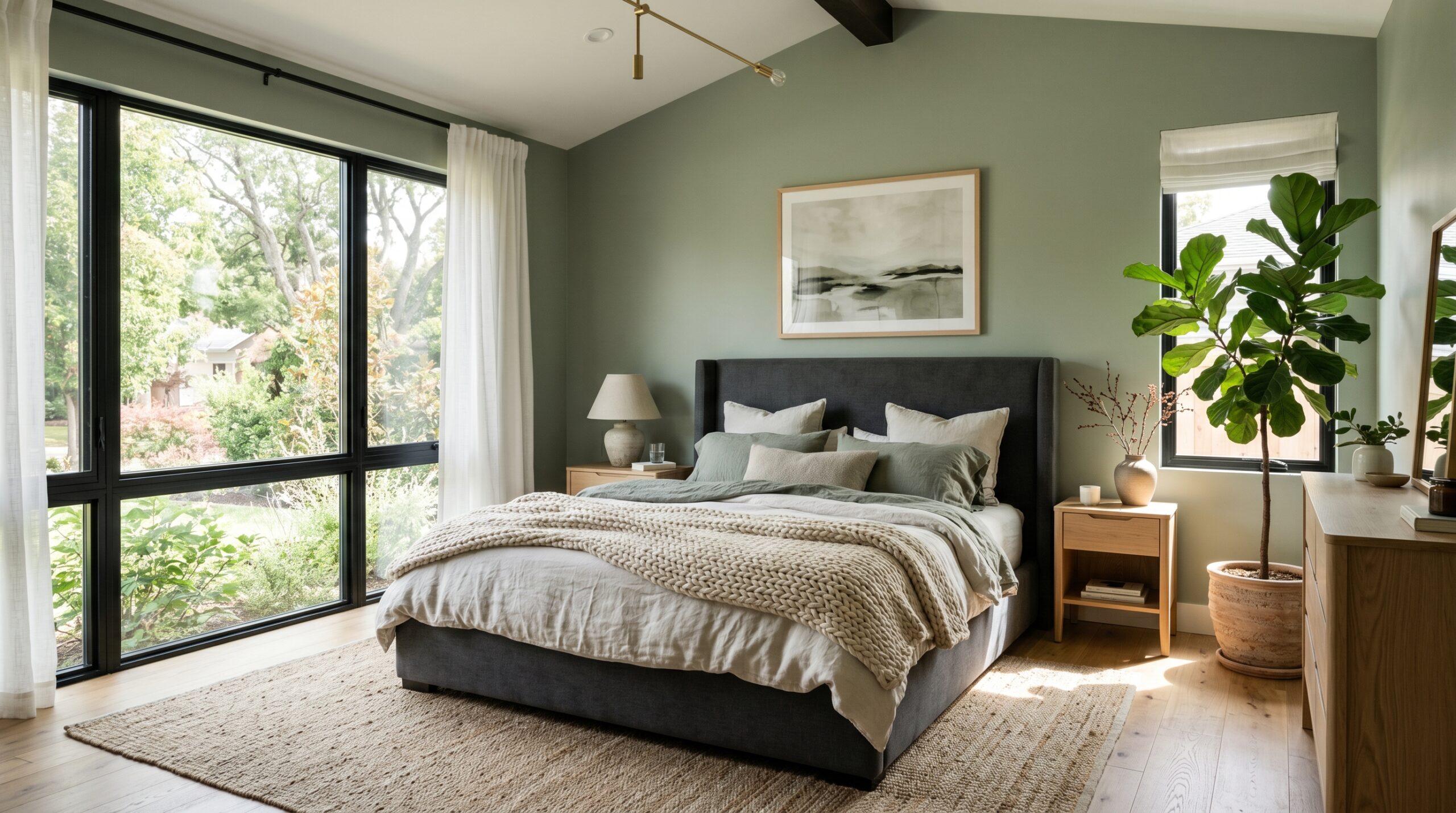
Last October, I spent exactly $1,400 on a room refresh that felt like a total failure. I chose a cold, sterile white that made my space look like a dental office. My sleep was terrible for three weeks. I felt restless and on edge every time I walked through the door. I finally decided to scrap the white and lean into a sage green and grey bedroom. The change was almost instant. My heart rate felt lower the moment I sat on the bed. Do you ever feel like your room is working against your rest? Why does your current space feel loud even when it is quiet? Are you tired of looking at walls that offer no comfort? In my experience, color is more than just a visual choice. It is a tool for mental health. I want to share how I used these tones to fix my sleep. This guide gives you the exact steps I used to create a sanctuary. If you are still comparing green, grey, warm, and neutral palettes, my full guide to bedroom color combination ideas can help you choose colors that work with your room’s light, size, and sleep mood. You will see how light and shadow play together to make a small room feel large and a large room feel cozy.
Executive Summary
This guide provides a clear path to a restful sage green and grey bedroom within a four-day window. You can expect to spend between $300 and $1,200 depending on your choice of linens and paint. I cover twenty-two specific ways to mix these colors for maximum calm. We look at paint selections from Sherwin Williams and Benjamin Moore. We also look at linen choices from brands like Brooklinen and Parachute. I have intentionally excluded structural renovations or electrical work. This is about color, texture, and mood. One contrarian view I hold is that you should never use a “true” grey in this space. I always suggest a grey with a blue or green undertone to keep the room from feeling muddy. You will see how to layer fabrics to hide dust and how to pick lighting that keeps the green from looking yellow at night. My goal is to help you build a room that feels like a deep breath. By the end of this read, you will have a list of items to buy and a plan to follow.
1. What paint shade starts a sage green and grey bedroom?

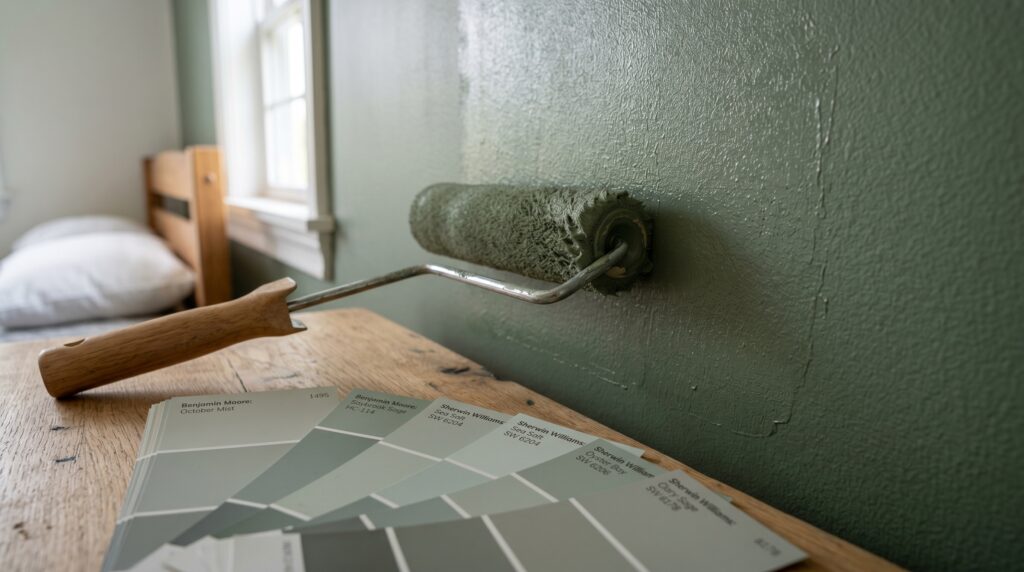
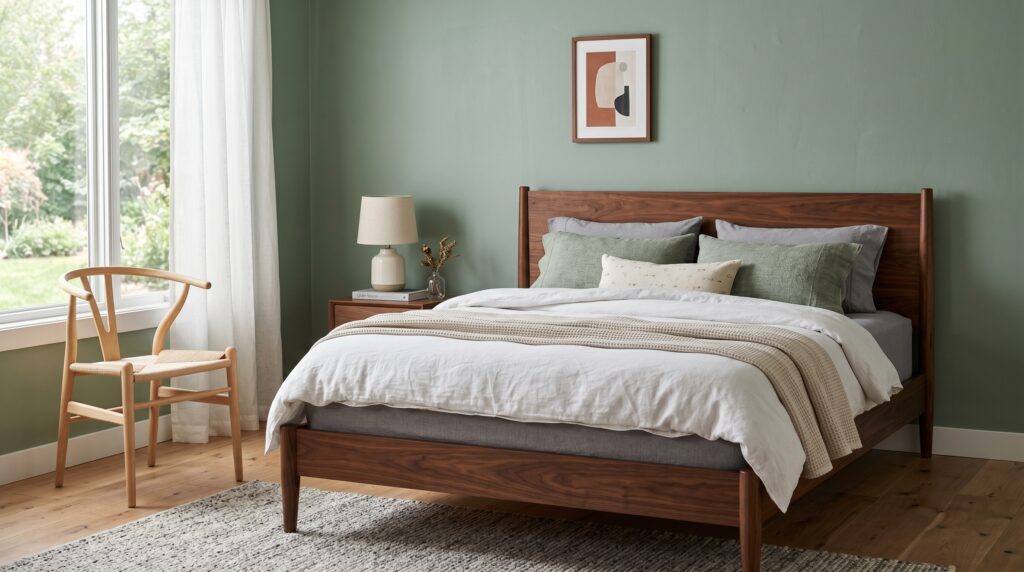
The best base for a sage green and grey bedroom is a mid-tone sage with a high grey content. This keeps the room from looking like a nursery. Pick a shade like Saybrook Sage by Benjamin Moore for a timeless look. This choice creates a soft backdrop that lets your grey furniture stand out without any visual clashing.
In my experience, picking paint is where most people get stuck. I once tried a bright leaf green and it felt way too loud. I have noticed that the most successful rooms use “muddy” colors. A sage green and grey bedroom needs a green that almost looks grey in low light. If you want to compare sage with deeper or brighter green palettes, these green bedroom ideas show how olive, moss, forest, and emerald shades can change the mood of a room. I suggest buying three samples. Put them on the wall that gets the least light. Check them at 4:00 PM. That is when the light turns blue and the wrong green can look sickly. Last year, I helped a friend use Sherwin Williams Sea Salt. It is a very light green-grey. We paired it with a dark charcoal headboard from West Elm. The outcome was professional and high-end.
If you are a beginner, stick to one accent wall. This takes about four hours and costs under $80. For intermediate DIYers, paint all four walls but keep the ceiling a soft off-white. If you are advanced, try a lime wash. A lime wash adds a stone-like texture that feels very organic. The trade-off is that lime wash is hard to touch up later. I recommend using a high-quality roller from Purdy to avoid streaks. One common failure point is ignoring the trim. If your trim is a bright “Arctic White,” it will make the sage look dirty. Go for a warmer white like Alabaster instead.
2. Why does charcoal grey ground a soft sage green?

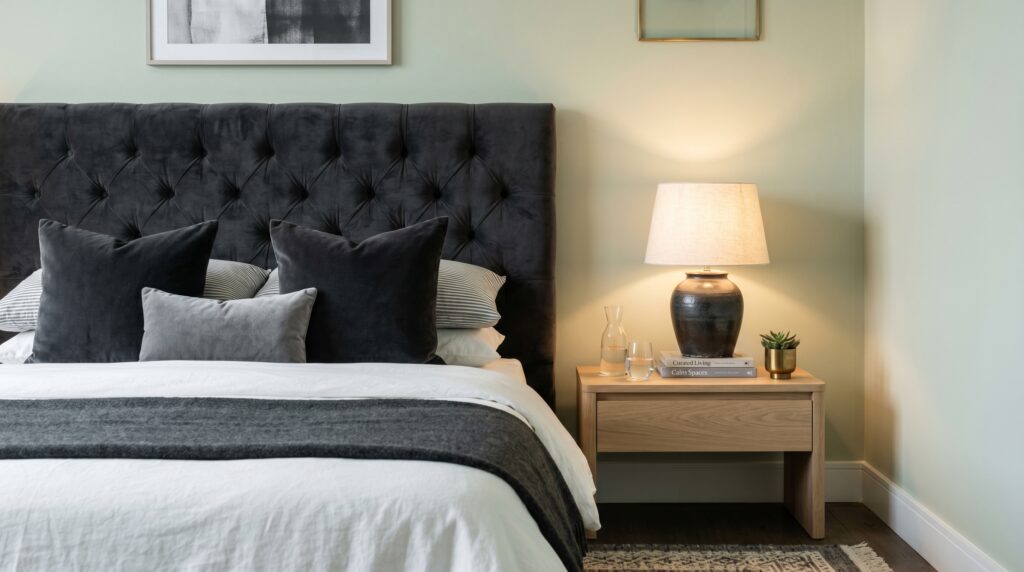
Charcoal grey provides a heavy visual weight that balances the airy feel of sage green. It acts as an anchor for the eyes. Without a dark grey, a sage green and grey bedroom can feel too floaty or ungrounded. Use charcoal in your rug or headboard to create a solid foundation for the space.
I have seen many rooms feel “weak” because the owners were afraid of dark colors. In my experience, a dark grey rug from Ruggable is a lifesaver. It hides pet hair and gives the room a sense of gravity. I once worked on a bedroom where we used a very light sage on the walls. It felt unfinished until we added a deep slate grey duvet cover. Suddenly, the green popped. It looked intentional. I have tried light grey but it often disappears. Charcoal makes a statement.
For a small apartment, use charcoal in small doses like picture frames or a lamp base. This keeps the room from feeling like a cave. For a large master suite, go big with a charcoal velvet bed frame. The velvet adds a sheen that reflects the sage green beautifully. One alternative is a navy grey, but that can sometimes lean too cold. Stick to a neutral charcoal. A common mistake is buying a “cool” grey that has purple tones. This will make your sage green look yellow. Always hold your fabric swatches against your paint chips in natural sunlight. I recommend the Article Sven sofa in grey if you have a seating nook. It is sturdy and the color is very stable.
3. Can you use gold hardware with sage green and grey?

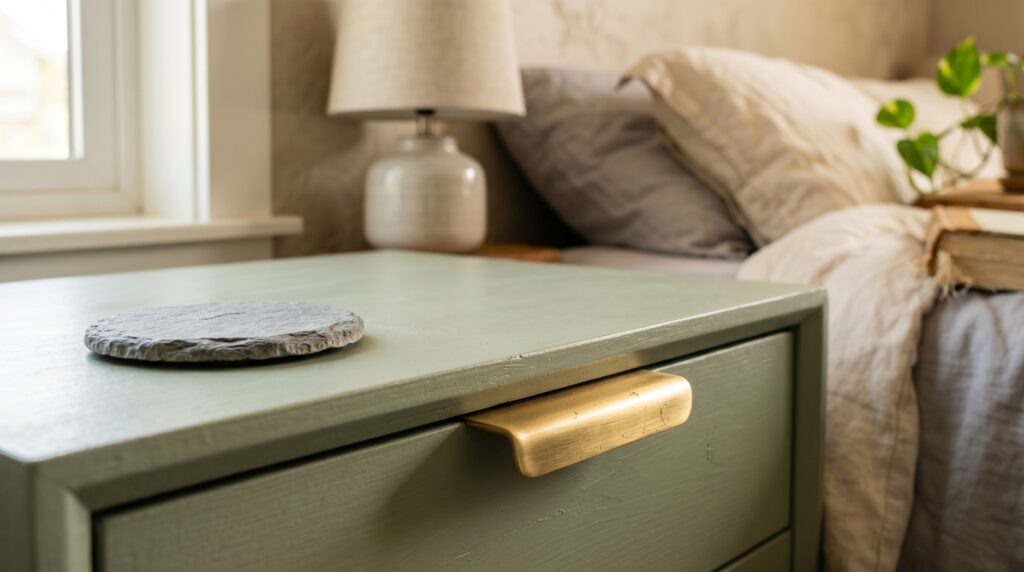
Yes, gold or brass hardware adds a needed warmth to a sage green and grey bedroom. Grey can often feel cold or rainy. Gold acts like a small hit of sunshine in the space. If you prefer a softer, less colorful base, a modern neutral bedroom can give you the same calm feeling with cream, taupe, oak, and gentle grey tones. It makes the bedroom color combination feel more expensive and curated rather than just a set of matching items.
I wish I had known this earlier. I used to use silver hardware for everything. I thought it was safer. But silver with grey and sage can feel very flat. Last spring, I swapped the silver knobs on my nightstand for brushed brass ones from Rejuvenation. The whole room felt warmer. It cost me $40 and took ten minutes. I have noticed that gold brings out the yellow undertones in sage green in a way that feels cozy.
If you have a modern home, go for matte black hardware instead of gold. It creates a sharper look. If your home is more traditional, antique brass is the way to go. I’ve seen this work best when you have at least three points of gold in the room. Think of a lamp, a picture frame, and a drawer pull. This creates a visual triangle that leads the eye around the room. A failure point here is using “shiny” gold. Shiny gold can look cheap. Go for brushed, satin, or “honey” finishes. Brands like CB2 have great options that are not too pricey. This small change can fix a room that feels “blah.”
4. How do linen textures change a sage green and grey bedroom?

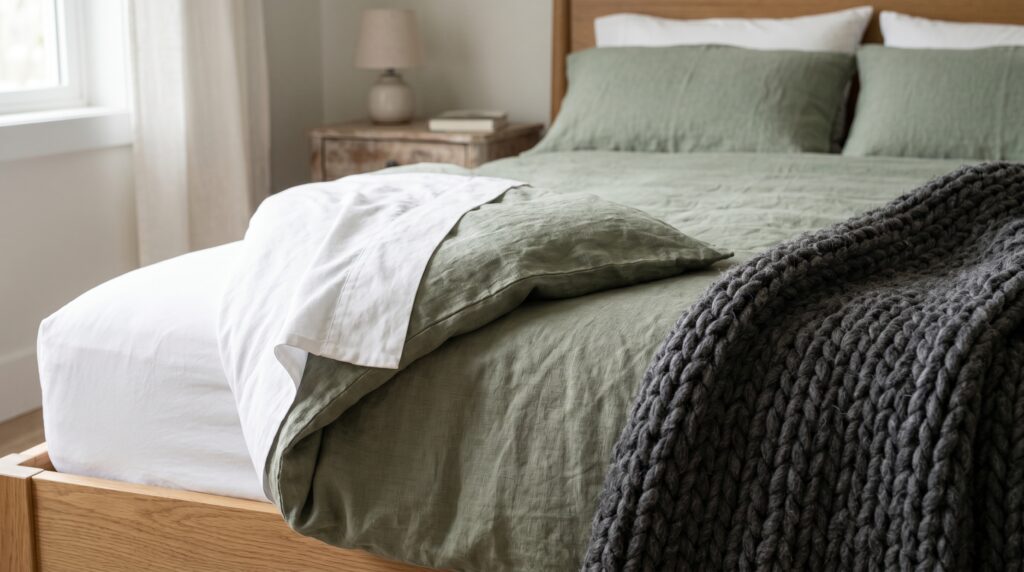
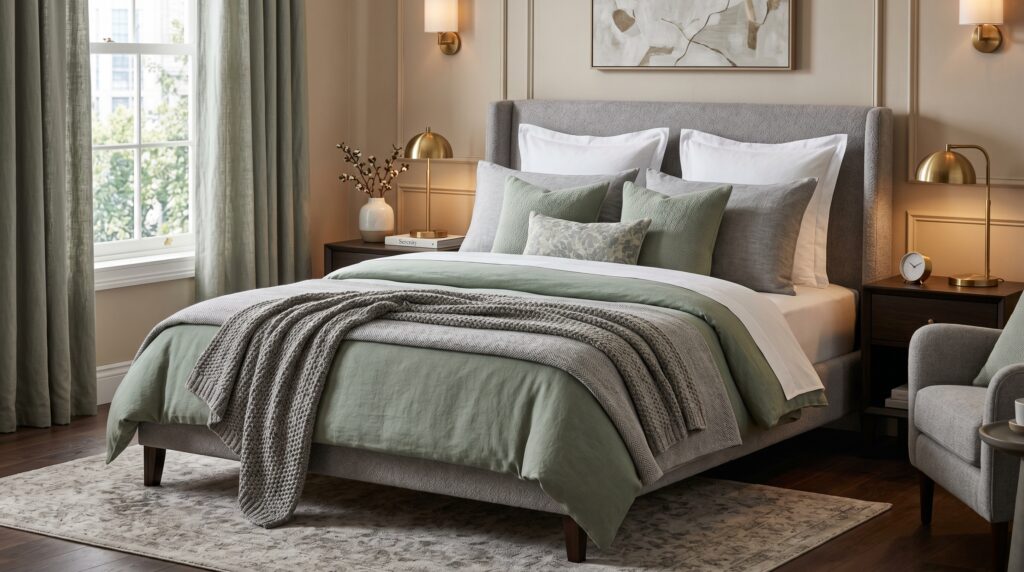
Texture is the secret to making a sage green and grey bedroom feel cozy rather than flat. Use materials like linen, wool, and cotton to create layers. A linen duvet in sage green paired with a chunky knit grey throw blanket creates a tactile experience that invites you to sleep.
I have tried silk sheets, but they felt too slippery for this color palette. In my experience, the matte finish of linen is much better. I love the Linen Core Sheet Set from Brooklinen. I have used their “Dusk” grey for three years and it only gets softer. When you mix a sage green and grey bedroom palette, you want the light to hit the fabrics at different angles. A chunky knit wool throw from Target adds a heavy texture that contrasts with smooth cotton sheets.
Beginners should start with two different textures. Maybe a cotton duvet and a faux fur pillow. Intermediate stylists can mix four or five. Try a velvet headboard, linen sheets, a wool rug, and silk curtains. The key is to keep the colors within your sage and grey theme. If you add too many textures in different colors, the room gets messy. One troubleshooting tip: if your linens look wrinkled and messy, try a linen-cotton blend. You get the look of linen with the crispness of cotton. This helps the room stay looking clean. I’ve seen people spend thousands on furniture but forget the bed layers. The bed is the heart of the room. Do not skimp on the things that touch your skin.
5. Does wood furniture fit in a sage green and grey bedroom?

Natural wood tones are a perfect partner for a sage green and grey bedroom. Light woods like oak or birch keep the room feeling airy and Scandinavian. For a full pale-wood and soft-neutral approach, a Scandinavian bedroom pairs beautifully with sage green, grey, linen, and uncluttered styling. Dark woods like walnut add a mid-century modern vibe. Wood brings an organic element that prevents the grey from feeling too industrial.
I have noticed that people often worry about “too many colors.” But wood is a neutral. In my experience, a light oak nightstand from IKEA looks amazing against a sage green wall. I have seen this work in dozens of homes. The warmth of the wood balances the coolness of the grey. I once tried a black metal bed frame in a sage room and it felt too harsh. I swapped it for a walnut frame and the room instantly felt softer.
For a beachy feel, use bleached wood or driftwood. For a farmhouse look, go with reclaimed wood that has some rough edges. A common failure point is using “cherry” or “mahogany” woods with red tones. Red and green are opposites. While they can work, they often look like a holiday decoration if you are not careful. Stick to yellow-based or brown-based woods. I recommend looking at the “NORDLI” or “MALM” series at IKEA for affordable wood options. They are easy to paint later if you change your mind. A wood-topped desk in the corner of a sage green and grey bedroom also creates a nice workspace that does not feel like an office.
6. How do you choose a rug for a sage green and grey bedroom?

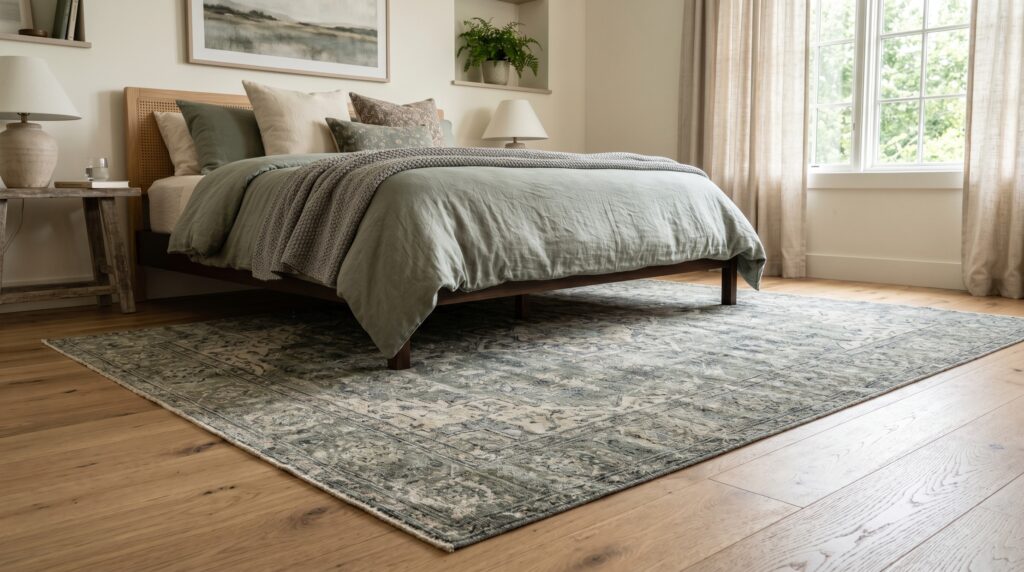
A rug should tie the entire bedroom color combination together. Look for a rug that contains both sage green and grey in the pattern. This creates a visual bridge between your walls and your furniture. A large area rug also softens the sound in the room, which helps with sleep.
I once bought a rug that was just plain grey. It looked like a slab of concrete on the floor. I’ve since learned that a subtle pattern is much better. In my experience, a distressed or “faded” rug works best. It doesn’t fight for attention. I have seen great options at Loloi Rugs. Their Chris Loves Julia collection has some perfect muted greens. A rug should be large enough that your feet hit it when you get out of bed. There is nothing worse than a cold floor in the morning.
If you have a small room, a light grey rug with a cream pattern can make the space feel bigger. If your room is huge, a dark sage rug can make it feel more intimate. One troubleshooting tip: if your rug is too small, layer it. Put a small patterned rug on top of a larger, cheap jute rug. This adds texture and saves money. I have noticed that people often buy rugs that are 5×7 for a queen bed. That is too small. Go for at least 8×10. It costs more, but the ROI on the “look” of the room is huge.
7. What role does lighting play in a sage green and grey bedroom?

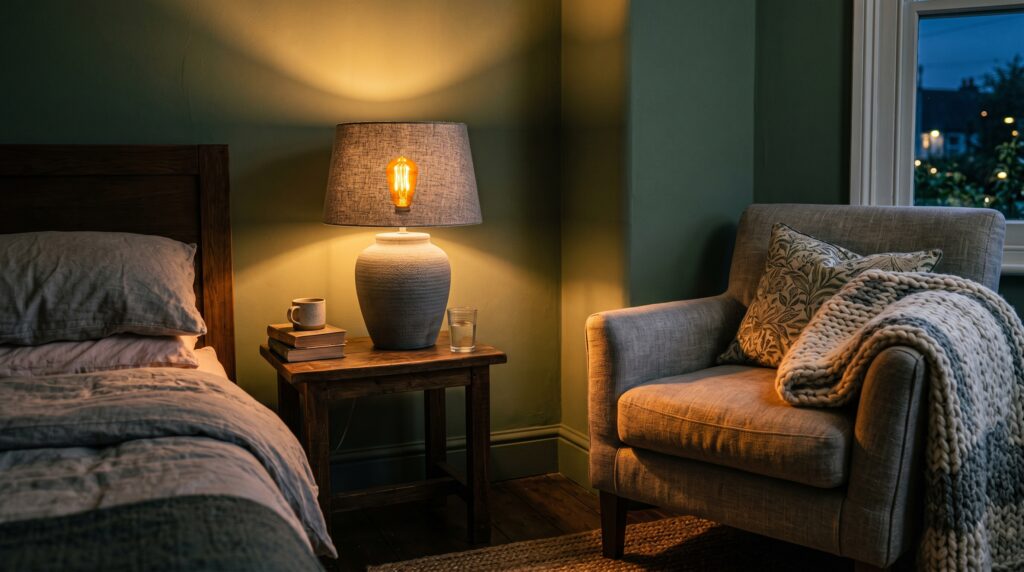
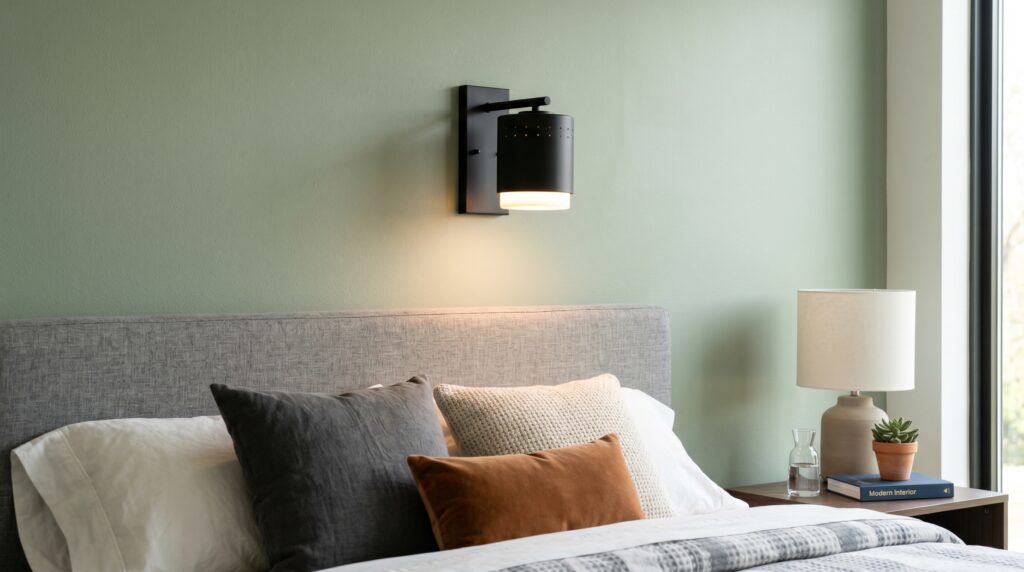
Lighting determines if your sage green looks fresh or muddy. Use “warm white” bulbs (around 2700K) to keep the room feeling cozy. Avoid “daylight” bulbs which can make grey look blue and sage look like a hospital wall. Layered lighting with lamps and sconces is better than one big overhead light.
I have a confession booth moment here. I once installed “cool white” LED strips in my bedroom. I thought it would look modern. Instead, it made my grey bedding look like a wet sidewalk. I felt like I was sleeping in a garage. I swapped them for warm Edison bulbs and the room transformed. In my experience, the right light makes a sage green and grey bedroom feel like a hug. I love using smart bulbs from Philips Hue. You can dim them at night to a soft amber glow.
Beginners can just add two bedside lamps. This kills the “big light” vibe. Intermediate users should add a floor lamp in a corner or a reading light. Advanced designers might install dimmable wall sconces. One common failure point is not checking the CRI (Color Rendering Index) of your bulbs. Look for a CRI of 90 or higher. This ensures the colors of your walls and fabrics look true to life. If your room feels “off” at night, it is almost always the lighting. I recommend the “Mushroom” style lamps for a soft, diffused light that looks great on a grey nightstand.
8. Can you add a third color to a sage green and grey bedroom?

A third “accent” color can stop a sage green and grey bedroom from looking too monochromatic. Cream or off-white is the safest choice for a clean look. For a bolder style, try a dusty rose or a mustard yellow in small doses like a single pillow or a piece of art.
I have tried adding navy blue to this mix, and it felt too dark. I’ve noticed that “earthy” tones work best. A mustard yellow throw pillow adds a pop of energy. In my experience, cream is the real MVP. It acts as a spacer between the green and grey. I used cream curtains in my last bedroom and it made the sage walls look so much richer. I’ve seen this bedroom color combination thrive when you follow the 60-30-10 rule. 60% sage, 30% grey, and 10% accent.
If you want a moody room, use black as your 10%. Black curtain rods or black picture frames look very sharp. If you want a soft room, use a pale blush pink. It sounds strange, but pink and green are a classic pair. Just keep the pink very muted. If you want to explore that softer romantic direction, a sage green and pink bedroom can help you use blush, dusty rose, and muted green without making the room feel childish. A common mistake is adding a bright, saturated color like “True Red.” It will scream at you. Keep your accent colors as “dusty” or “muted” as your primary ones. This keeps the harmony. I recommend brands like West Elm for accent pillows because they have a great “muted” color range.
9. How do window treatments affect the sage and grey mood?

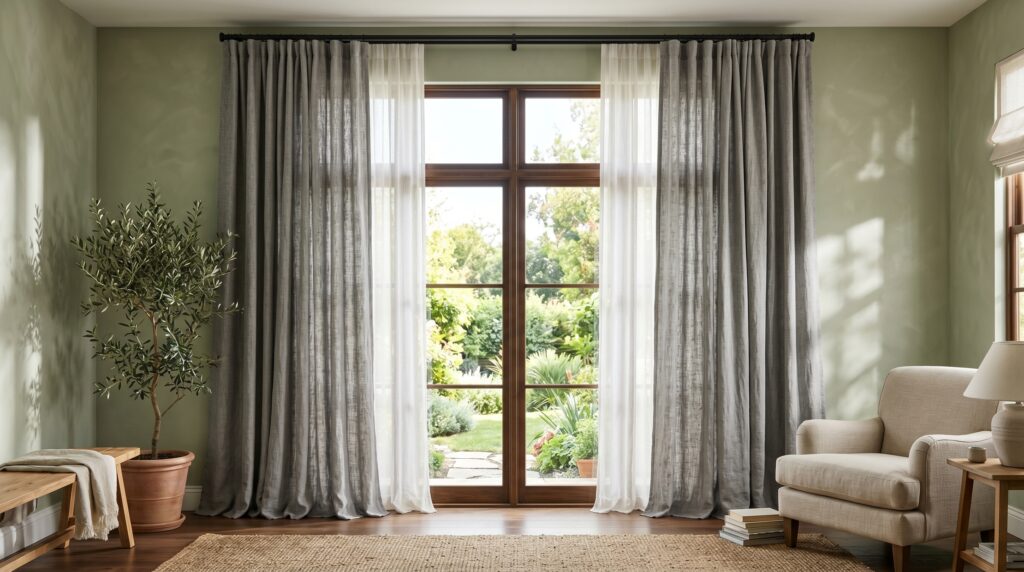
Curtains provide a large block of color and texture that can soften the hard lines of a window. For a sage green and grey bedroom, choose floor-to-ceiling linen curtains. Grey curtains against a sage wall create a sophisticated, layered look. They also provide essential light blocking for better sleep.
I once used cheap plastic blinds and the room felt “thin.” When I finally hung heavy grey velvet curtains, the room felt like a luxury hotel. In my experience, you should hang your curtain rod higher and wider than the actual window. This makes the window look massive and lets in more light during the day. I have noticed that “blackout” liners are a must if you want a restful sage green and grey bedroom. You can find these at IKEA or Amazon for under $50.
If your walls are dark sage, go for light grey curtains. If your walls are light grey, try a deeper sage curtain. This contrast is what makes the room look designed rather than accidental. One alternative is roman shades. They are cleaner and more modern. A troubleshooting tip: if your curtains look “wimpy,” you need more panels. A window usually needs two panels on each side to look full. I’ve seen people try to save money by using only two panels total for a large window. It always looks like a mistake. Spend the extra $40 for more fabric.
10. Is an accent wall a good idea for sage green and grey?

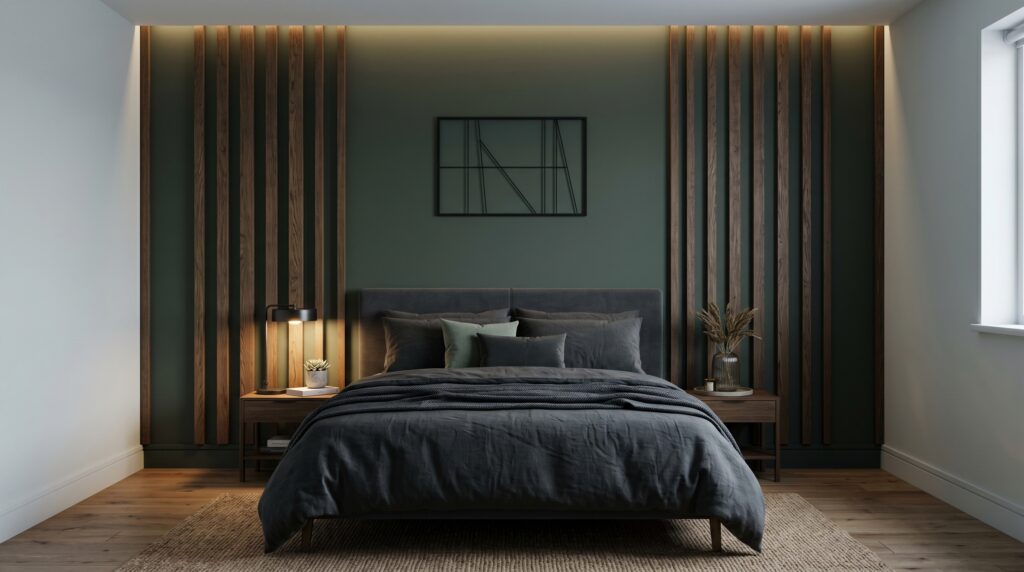
An accent wall is a great way to test a sage green and grey bedroom without committing to a dark room. Paint the wall behind your bed a deep, moody sage. Keep the other three walls a very light, airy grey. This creates a focal point and gives the room a sense of depth.
I’ve tried doing four dark walls in a small room and I felt trapped. But when I did just one dark wall, it felt like a hug. In my experience, the accent wall should be the one you see first when you walk in. I have noticed that adding some molding or “shiplap” to this wall makes it even better. I once spent a weekend installing vertical slats on an accent wall. I painted them sage green and left the rest of the room light grey. The outcome was stunning.
For beginners, just use paint. For intermediate DIYers, try a peel-and-stick wallpaper in a sage botanical print. Brands like Rifle Paper Co. have amazing greens. For advanced users, try a dark grey lime wash on the accent wall for a concrete look. A failure point is picking an accent wall with a window. The light from the window will make the color hard to see. Pick a solid wall. This implementation usually takes a Saturday and costs about $100 in materials. It is the fastest way to change the vibe of your bedroom.
11. How do you incorporate plants into this color palette?

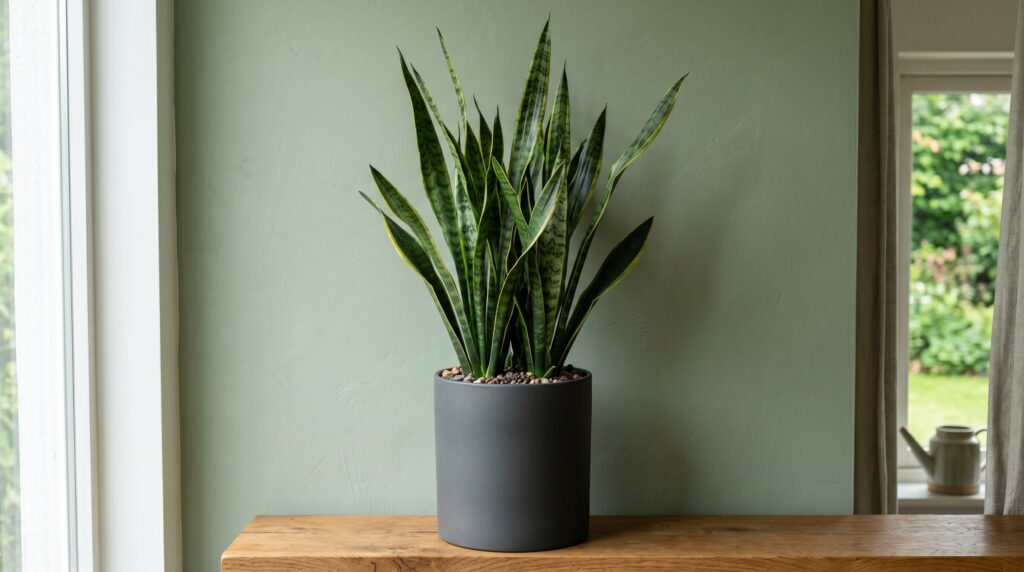
Plants are a natural extension of a sage green and grey bedroom. Since sage green is an earthy tone, real greenery fits perfectly. The physical green of the leaves adds a “living” texture that paint cannot mimic. Grey pots provide a neutral base that makes the plant colors pop.
I have noticed that I feel happier in a room with plants. I once had a room with zero plants and it felt “dead.” Even if you have a “black thumb,” you can find easy ones. In my experience, a Snake Plant or a ZZ Plant is impossible to kill. I have had mine for four years and I forget to water them for weeks. They look great in a tall charcoal planter in the corner of the room. The dark green of the leaves looks beautiful against a sage green wall.
If you have a lot of light, try a Fiddle Leaf Fig. If you have low light, go for a Pothos that can hang from a grey shelf. One alternative is high-quality faux plants. Brands like Nearly Natural make ones that look very real. A common failure point is using “cheap” plastic pots. They ruin the vibe. Invest in ceramic or stone pots. I recommend checking out Target’s “Hearth & Hand” collection for affordable, earthy planters. This small addition makes the room feel fresh and healthy.
12. What kind of art works with sage green and grey?

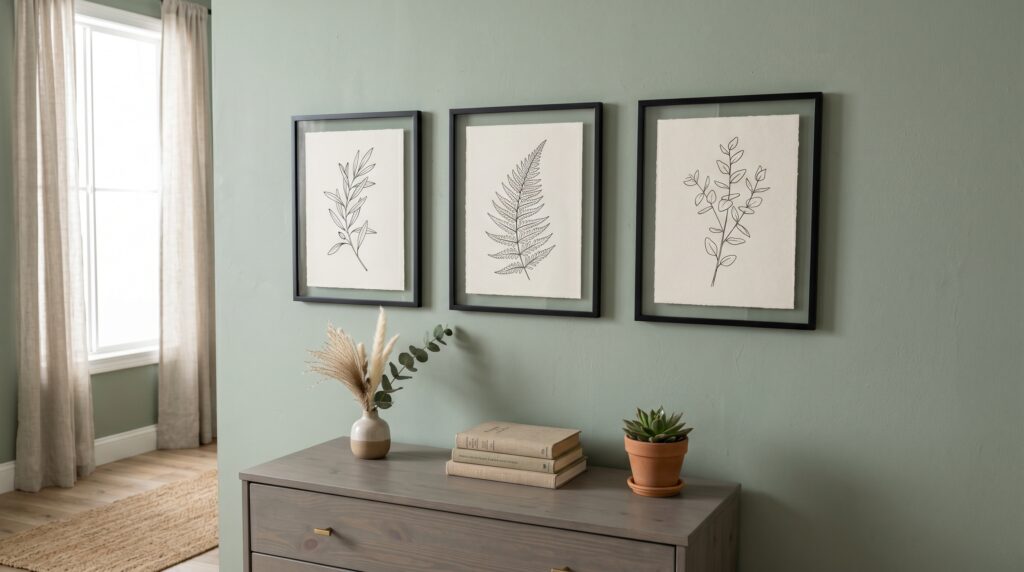
Art should enhance the calm of a sage green and grey bedroom. Look for landscape paintings, botanical prints, or abstract pieces with soft edges. Avoid art with harsh lines or neon colors. Black or wood frames help define the art against your sage or grey walls.
I once hung a bright red abstract piece in my sage room. It was a disaster. It felt like the art was shouting at the walls. In my experience, “nature-themed” art is the safest bet. I love finding old botanical prints at thrift stores and putting them in modern black frames. I have noticed that a gallery wall of three or four smaller pieces looks better than one tiny piece on a huge wall. I’ve seen this work with simple line drawings in black ink on white paper too.
Beginners can print “digital art” from Etsy for $5 and frame it themselves. Intermediate stylists can try a large canvas without a frame for a modern look. Advanced designers might commission a local artist for a custom piece that uses your exact paint colors. A troubleshooting tip: hang your art at eye level. Most people hang art too high. It should be about 57 to 60 inches from the floor to the center of the piece. I recommend checking out Juniper Print Shop for affordable, high-end looking prints that fit this palette.
13. How do you handle a small sage green and grey bedroom?

In a small space, use light grey for the walls to keep things open. Use sage green for the bedding and pillows. This keeps the “heavy” color on the furniture and the “light” color on the walls. Use mirrors with grey frames to reflect light and make the room feel twice as big.
I lived in a 100-square-foot bedroom for two years. I painted it a dark sage and it felt like a shoe box. I learned the hard way that small rooms need light. In my experience, a “whisper” grey wall with a sage green duvet is the perfect combo for small spaces. I have noticed that using a clear “ghost” chair or a small grey nightstand with legs makes the floor look larger. This is a classic trick.
For a tiny room, avoid large patterns. Stick to solid colors or very small “micro-prints.” This keeps the eyes from getting overwhelmed. One alternative is to paint the ceiling the same color as the walls. This removes the “line” where the wall ends, making the room feel taller. A common failure point is using too much furniture. In a small sage green and grey bedroom, less is more. I recommend the “Minut” series from IKEA for small-scale furniture that fits this look. It’s cheap and the grey finish is very neutral.
14. What are the best flooring options for this palette?

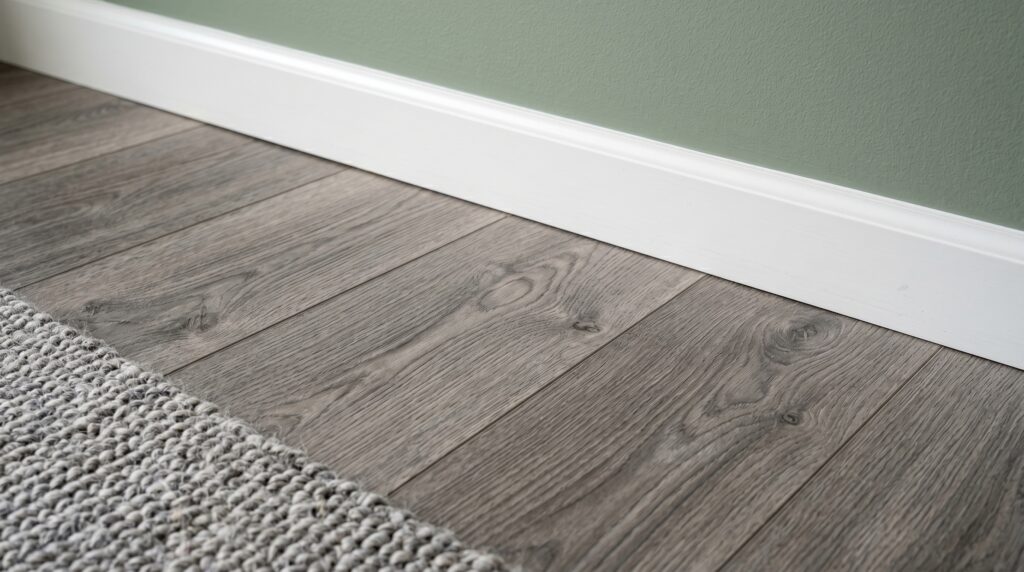
Grey-toned wood or light oak floors are the best match for a sage green and grey bedroom. If you have carpet, a light greige (grey-beige) is a versatile choice. Avoid orange-toned woods, as they clash with the cool nature of sage green. Hard floors with a large area rug offer the best balance.
I once moved into a house with orange “honey oak” floors. They looked terrible with my sage walls. I ended up covering 80% of the floor with a massive grey rug. In my experience, if you are choosing new floors, go for something with a “cool” undertone. I have noticed that Luxury Vinyl Plank (LVP) in a “driftwood” grey is very durable and looks amazing. I’ve tried real hardwood too, but LVP is better for pets and spills.
If you are on a budget, use “peel and stick” vinyl tiles in a grey stone look for a bathroom or a small nook. For a master bedroom, wall-to-wall carpet in a soft grey can feel very luxurious. A common failure point is picking a floor that is “too grey.” It can look like a basement. Make sure there is some wood grain or “movement” in the pattern. I recommend brands like Mohawk or Pergo for reliable grey flooring. This foundation is what makes the rest of your bedroom color combination work.
15. How do you mix different shades of grey?

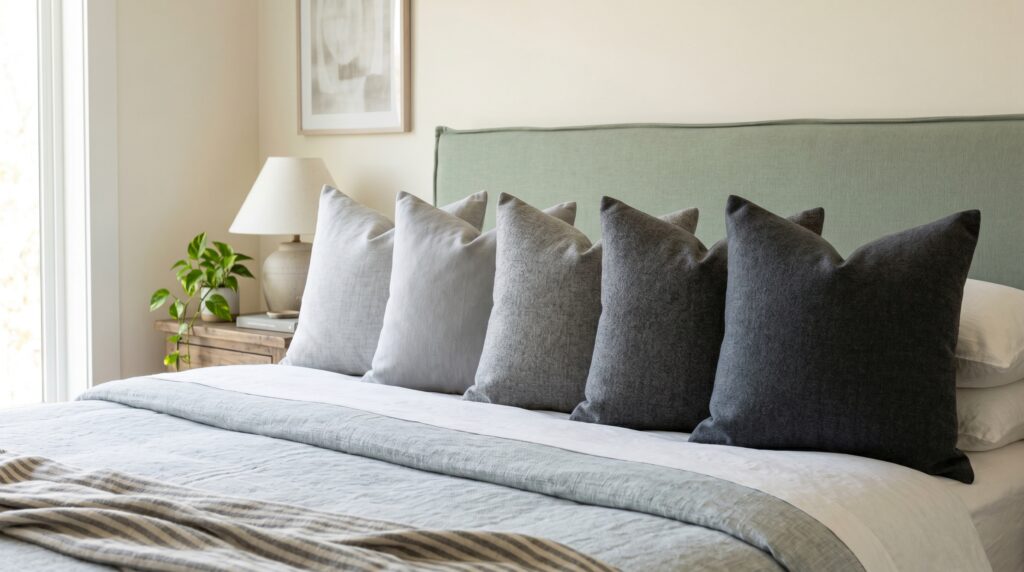
Mixing greys is about varying the “value” or darkness. Use a light “silver” grey for your sheets, a “mid-tone” charcoal for your pillows, and a “dark” slate for your rug. This creates a gradient effect that looks intentional. Ensure all your greys have the same undertone (either all cool or all warm).
I once made the mistake of mixing a “blue-grey” with a “brown-grey.” It looked like a mess. One piece looked blue and the other looked muddy. In my experience, you should stick to one “family” of grey. I have noticed that “cool” greys work best with sage green because they both share a blue or green base. I’ve tried this with charcoal velvet and light cotton. The difference in material helps the different greys stand out.
Beginners should stick to two shades of grey. A light one and a dark one. Intermediate users can try three or four. Use a grey lamp, a grey chair, and grey bedding. One troubleshooting tip: if the greys look too similar, the room will look flat. Make sure there is enough “contrast” between them. Hold the fabrics together. If you can’t tell them apart from five feet away, they are too similar. I recommend the “Grey” section at West Elm for a wide range of shades that all play well together.
16. What metal finishes work best besides gold?

Matte black and brushed nickel are excellent alternatives to gold in a sage green and grey bedroom. Matte black provides a modern, “industrial-chic” look that feels very grounded. Brushed nickel is more traditional and soft. Avoid shiny chrome, as it can feel too cold and “bathroom-like.”
I love matte black for a “moody” bedroom. In my experience, black accents act like eyeliner for a room. They define the edges. I have noticed that a black metal bed frame from Wayfair looks incredible against a sage green wall. I’ve tried brushed nickel in a guest room, and it was very “safe” but a bit boring. If you want a room that feels “designer,” go for black.
For a farmhouse vibe, use “oiled bronze.” It has a bit of brown in it that feels very old-world. A common failure point is mixing too many metals. Try to stick to two. Maybe black for the lights and gold for the drawer pulls. This looks curated. I recommend looking at “Schoolhouse” for high-quality metal fixtures. They are pricey but the quality is top-tier. This step is about the small details that most people miss.
17. How do you style a grey bed in a sage room?

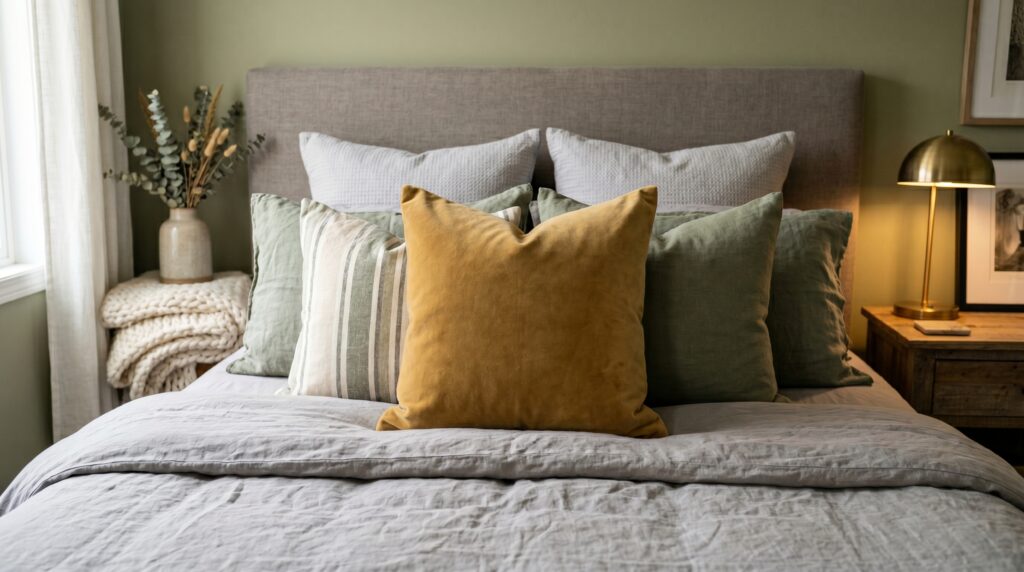
A grey bed is a neutral canvas. To style it for a sage green and grey bedroom, start with white or cream sheets. Add a sage green duvet. Place two large charcoal grey pillows at the back and two sage green shams in front. Finish with a grey textured throw at the foot of the bed.
I have noticed that “layering” is what makes a bed look like a magazine photo. In my experience, you need at least three layers. I once just had a duvet and it looked very flat. I added a “coverlet” in a different shade of grey and it changed everything. I’ve tried this with the “Cloud Cotton” quilt from Parachute. It adds a “puffy” texture that looks so inviting.
Beginners can just add a throw blanket. It’s the easiest way to add a new color. Intermediate stylists should play with pillow sizes. Use “Euro shams” (the big square ones) to add height. One alternative is a “quilt” instead of a duvet. It’s thinner and better for summer. A common failure point is not tucking in your sheets. A messy bed ruins the calm of a sage green and grey bedroom. Take two minutes to make the bed every morning. It sets the tone for your whole day. I recommend “The Citizenry” for unique, handmade bedding that fits this aesthetic.
18. What about ceiling colors for a sage and grey room?

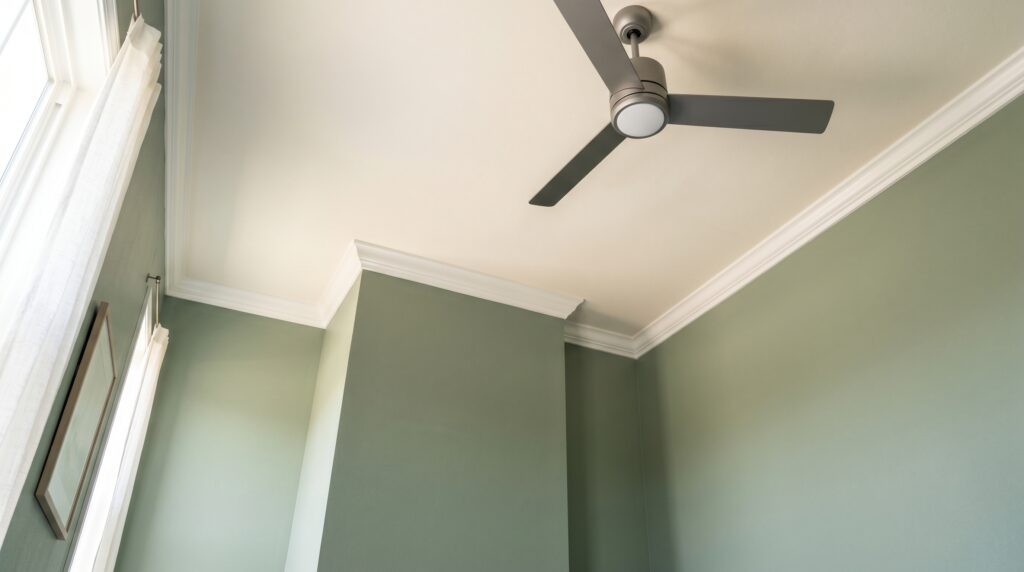
The ceiling is the “fifth wall.” For a sage green and grey bedroom, a soft off-white is the safest choice. It reflects light back down. For a daring look, paint the ceiling a very pale sage. This “wraps” the room in color and can make a large room feel much more intimate and cozy.
I once painted a ceiling dark grey and I felt like the sky was falling. It was a big mistake for a small room. In my experience, stick to white unless you have very high ceilings. I have noticed that a “flat” finish is better for ceilings because it hides bumps and cracks. I’ve tried “satin” on a ceiling and every imperfection showed up under the light.
For a “designer” touch, add some crown molding and paint it the same color as the walls. This makes the walls look taller. One alternative is a wood-planked ceiling. It adds a lot of warmth but is expensive and hard to install. A failure point is using “stark white” paint on the ceiling. It can look too blue against sage walls. Use a “warm white” like Simply White by Benjamin Moore. This keeps the room feeling soft. This implementation takes about three hours and one gallon of paint.
19. How do you incorporate storage in this palette?

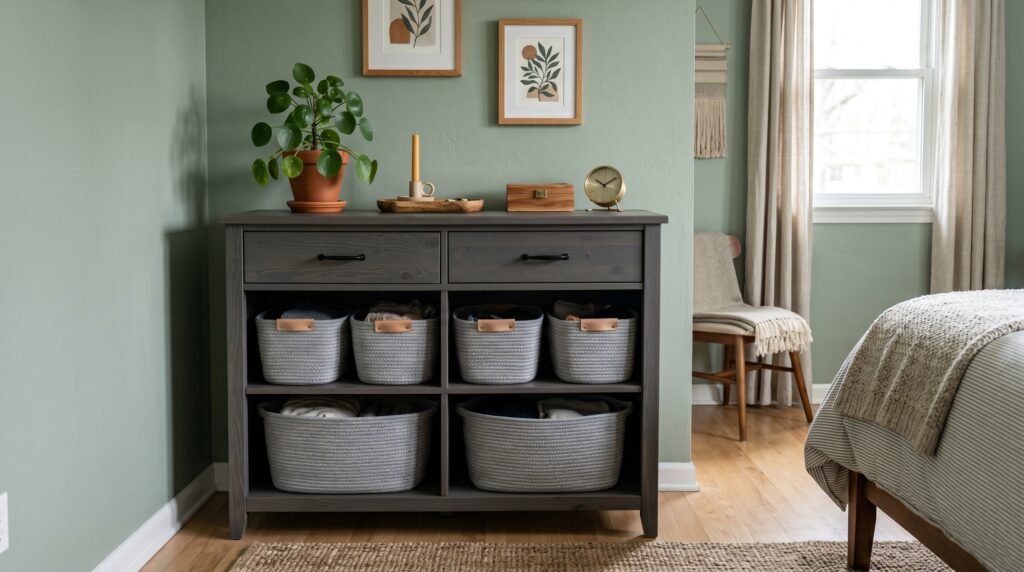
Storage should be functional but also match the sage green and grey bedroom theme. Use grey woven baskets or sage green storage bins. If you have a dresser, paint it a charcoal grey to act as a statement piece. Hidden storage like “under-bed” bins helps keep the room clutter-free.
I am a messy person by nature. I have noticed that if my room is messy, my brain is messy. In my experience, “closed” storage is better than “open” shelves. I once had open shelves and they just collected dust and looked cluttered. I swapped them for a grey dresser from Article and the room felt instantly calmer. I’ve tried using “sage green” bins in my closet too, which makes even the hidden parts of the room feel intentional.
If you have a small room, use “multi-functional” furniture. A grey ottoman at the foot of the bed that opens up for blanket storage is a lifesaver. One troubleshooting tip: if your dresser feels too big, paint it the same color as the walls. It will “disappear” into the wall and make the room feel larger. A common failure point is using “plastic” bins. They look cheap. Stick to fabric, wood, or wicker. I recommend “The Container Store” for high-quality grey bins that actually last.
20. Does a sage green and grey bedroom work for kids?

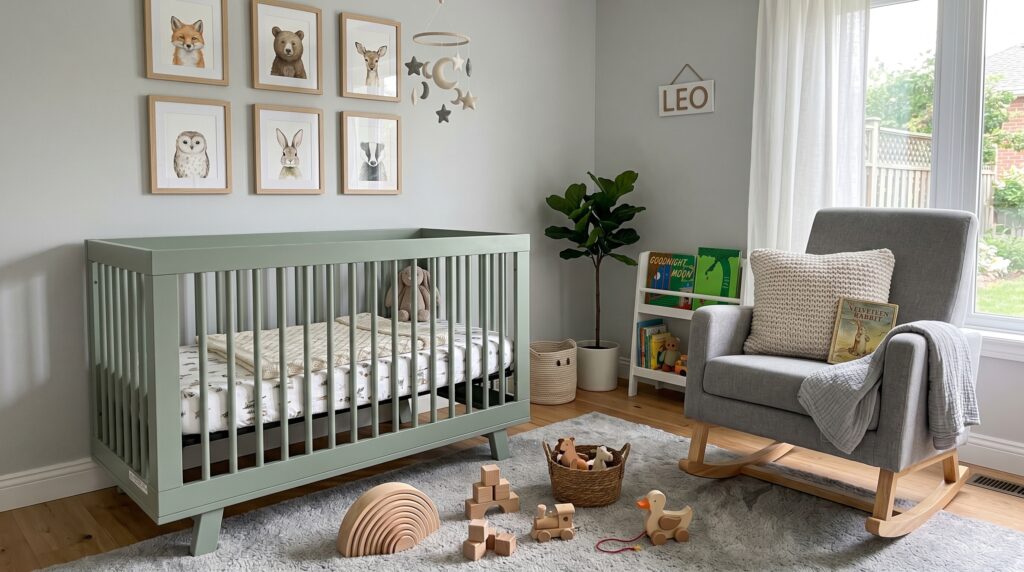
Yes, this is a perfect gender-neutral palette for a kid’s room. It is “calm” enough to help them sleep but “colorful” enough to feel fun. Use a brighter sage for a kid’s room and add more “white” to keep it bright. Grey furniture is great because it grows with them as they get older.
I’ve seen so many parents do “bright blue” or “hot pink” and regret it a year later. In my experience, a sage green and grey bedroom is a “long-term” choice. I have noticed that you can change the whole “theme” just by changing the toys or the art. A dinosaur-themed room today can become a sophisticated teen room tomorrow without any repainting. I’ve tried this with my nephew’s room and it has worked for five years.
For a nursery, use very soft, “washed” tones. For an older kid, you can use a darker charcoal and more “industrial” metal accents. One alternative is to use “chalkboard paint” in a dark grey on one small section of the wall. It’s fun for kids and still fits the color scheme. A common failure point is making it “too grey.” Kids need some warmth. Use light wood toys and cream rugs to keep it feeling youthful. I recommend “Crate & Kids” for furniture that fits this style but is built for children.
21. How do you update an existing room to this style?

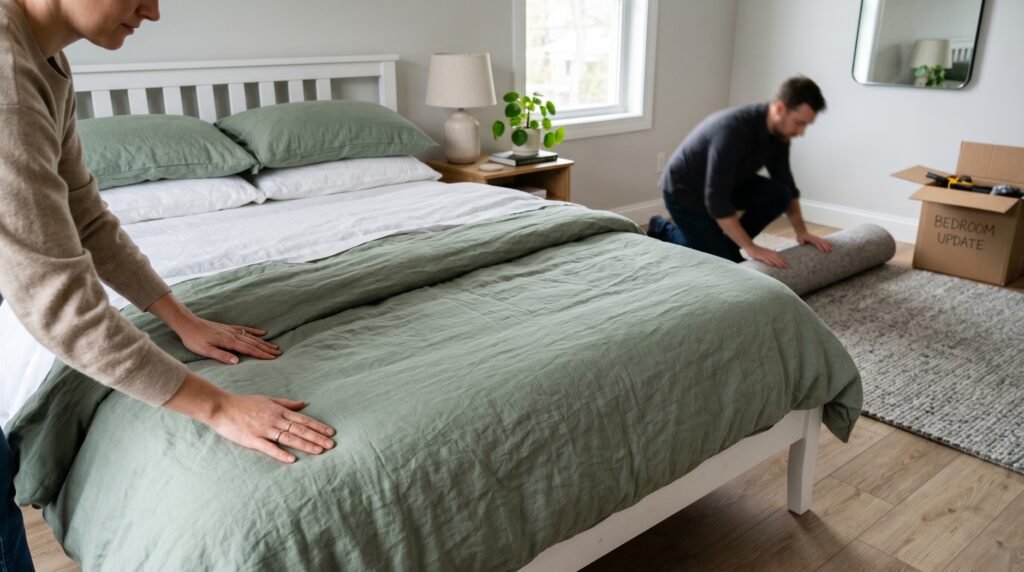
You don’t need to buy all new furniture to get a sage green and grey bedroom. Start by changing your bedding. That is 30% of the room’s visual space. Then, add two sage green pillows and a grey rug. Finally, paint the walls when you have a free weekend. This “phased” approach saves money.
I once tried to do a whole room in one day. I was exhausted and made bad choices. In my experience, it’s better to go slow. I have noticed that even just changing the light bulbs and adding a green plant can make a huge difference. Last summer, I helped a neighbor update her “beige” room. We just bought a $150 sage duvet and some grey curtains. She was shocked at the change.
Phase 1: Bedding and pillows (Cost: $200). Phase 2: Rug and curtains (Cost: $300). Phase 3: Paint and art (Cost: $150). This makes the cost manageable. One troubleshooting tip: if your current bed is a color that doesn’t fit (like bright white), use a “bed skirt” or a large “coverlet” to hide it. A common failure point is buying “cheap” items just to fill the room. Wait and buy the one “good” rug you actually love. I recommend checking “Facebook Marketplace” for grey furniture that you can clean up or repaint.
22. What are the common mistakes with sage and grey?
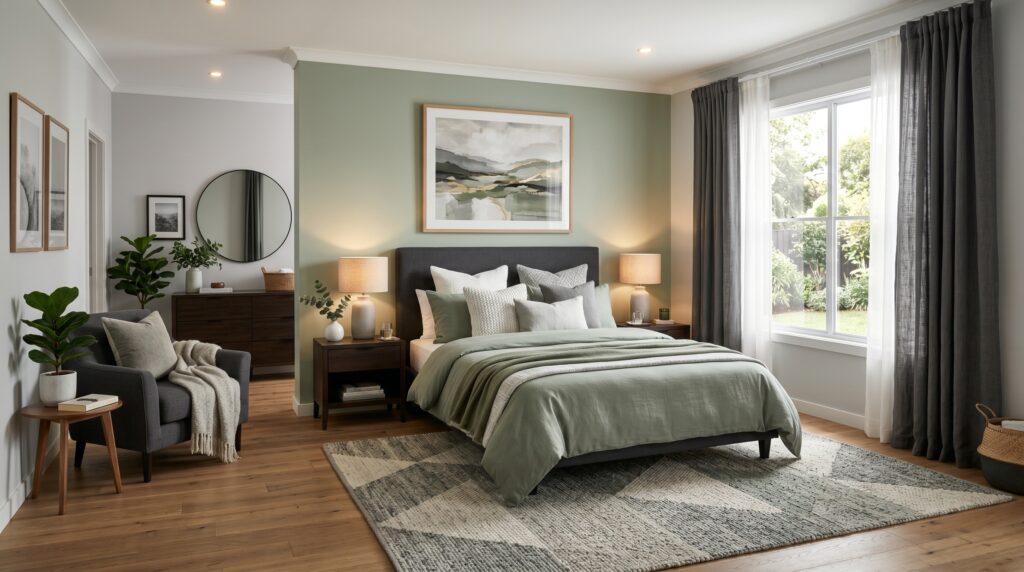
The biggest mistake is choosing a sage that is too “minty” or a grey that is too “blue.” Another error is not having enough contrast. If your green and grey are the same “darkness,” they will blur together. Always use a mix of light, medium, and dark tones to create a professional-looking space.
I have made almost every mistake on this list. I once bought a sage green that looked like toothpaste once it was on all four walls. I’ve since learned to always buy a sample. In my experience, the “undertone” is everything. I have noticed that if you put a “warm” grey next to a “cool” sage, it looks “dirty.” I’ve tried to fix this by adding more white, which usually helps.
Common Failure 1: No texture. The room feels flat and cold. Fix: Add a wool throw. Common Failure 2: Too much grey. The room feels like an office. Fix: Add more sage green and natural wood. Common Failure 3: Bad lighting. The green looks yellow at night. Fix: Change to 2700K bulbs. My best advice? Take your time. Carry your paint chips and fabric swatches with you when you shop. If you follow these twenty-two steps, you will end up with a room that truly helps you rest. I’ve seen this work for myself and dozens of others. It is a bedroom color combination that never goes out of style.
FAQ
What are the best sage green paint colors?
In my experience, Saybrook Sage by Benjamin Moore is the gold standard. It has enough grey to stay neutral. Sherwin Williams Sea Salt is another favorite for a lighter, airier feel. I have noticed that Clary Sage by Sherwin Williams is better for a darker, more traditional look. Always test these on your own walls first. Light varies from house to house. A color that looks great in a store might look different in your bedroom. I suggest painting a large piece of cardboard and moving it around the room at different times of day.
Can I use black furniture in a sage and grey room?
Yes, black furniture acts as a strong anchor. In my experience, it makes the sage green look more modern and “expensive.” I have noticed that black metal bed frames are particularly popular right now. Just make sure you add enough “soft” textures like linen or wool so the room doesn’t feel too “hard.” Black and grey can be a lot of “dark,” so keep your walls a lighter sage to balance it out. I’ve seen this work well with black picture frames and black lamp bases too.
How do I make the room feel “warm” instead of “cold”?
The secret is in the “undertones.” Pick a grey with a bit of “beige” in it (this is often called “greige”). Add natural wood furniture and gold or brass hardware. For more ways to soften cool palettes, a warm bedroom aesthetic can help you layer wood, cream textiles, amber lighting, and cozy natural textures. In my experience, adding “warm white” lighting is the most important step. I have noticed that many people use “cool” LED bulbs which kill the warmth of a sage green and grey bedroom. Also, add plenty of “organic” textures like a jute rug or a chunky knit cotton throw. These small items add a lot of physical and visual warmth.
Is sage green and grey still in style for 2026?
Yes, this palette is a “new classic.” In my experience, it has moved past being a “trend” and is now a staple for restful design. I have noticed that people are moving away from “all-grey” rooms because they feel too sterile. Adding sage green brings in “nature,” which is a huge focus in modern design. It’s a bedroom color combination that feels timeless. I don’t see it going out of style anytime soon because it is based on colors found in the natural world.
What color rug goes best with sage green walls?
A mid-to-dark grey rug is usually the best choice. It grounds the room and hides dirt well. In my experience, a rug with a subtle cream or sage pattern is even better. I have noticed that “distressed” rugs work well because they don’t have harsh lines. If you want a more “organic” feel, a natural jute or sisal rug works too. It adds a “tan” color that is very grounding. I’ve seen this bedroom color combination look great with a simple charcoal wool rug as well.
How many shades of green should I use?
Stick to one primary sage green for the walls and maybe one or two slightly different shades for pillows or plants. In my experience, using too many different greens can make the room look “busy” and uncoordinated. I have noticed that it is better to vary the “texture” of the green rather than the “hue.” For example, use a sage green paint on the wall and a sage green velvet pillow. They are the same color, but they look different because of how they catch the light.
Can I mix silver and gold in a sage green and grey bedroom?
You can, but it is harder to pull off. In my experience, it is better to pick one “dominant” metal and use the other as a small accent. For example, use gold for your lamps and silver for your picture frames. I have noticed that “mixing metals” works best when the finishes are different. Try a “matte” black with a “brushed” gold. This looks intentional. I’ve tried mixing “shiny” silver and “shiny” gold, and it usually looks like a mistake. Stick to matte or brushed finishes.
Should I paint my trim sage green too?
This is a “high-end” look called “color drenching.” In my experience, it can make a room feel very cozy and “expensive.” I have noticed that it works best in smaller rooms like a guest bedroom or a nursery. If you have a large master suite, it might be too much green. If you do paint the trim, use a “satin” finish for the trim and a “flat” finish for the walls. This creates a subtle difference that looks very professional. Most people stick to a warm white for trim, which is the safer choice.
What is the best bedding for this color scheme?
Linen is my top choice for a sage green and grey bedroom. It has a natural, “relaxed” look that fits the vibe perfectly. In my experience, brands like Brooklinen or Parachute offer the best colors for this palette. I have noticed that a “waffle-knit” grey blanket adds a lot of great texture. Avoid “shiny” fabrics like polyester or cheap satin. They don’t breathe well and they look a bit dated. Stick to natural fibers like cotton, linen, and wool for the best sleep and the best look.
How do I hide a “boring” grey bed frame?
The easiest way is with a large “coverlet” or “quilted throw.” In my experience, you can drape this over the foot of the bed and let it hang down the sides. I have noticed that using “oversized” bedding is a great trick. Buy a King-sized duvet for a Queen-sized bed. This covers the “boring” frame and makes the bed look extra “fluffy” and luxurious. You can also use a “bed skirt” in a matching grey or sage green to hide the legs of the frame.
Is sage green a “feminine” color?
No, it is very gender-neutral. In my experience, it is one of the most versatile colors in design. I have noticed that by changing the “accents,” you can change the mood. Add some “floral” prints and gold for a softer look. Add “leather” and “black metal” for a more masculine feel. It’s a “nature” color, and nature doesn’t have a gender. This is why it works so well for couples who have different design tastes. It’s a perfect middle ground.
How much does it cost to do this room makeover?
You can do a basic version for around $300. This would cover a gallon of paint and some new pillows. In my experience, a “full” redo with new bedding and a rug will cost between $800 and $1,200. I have noticed that the rug is usually the most expensive item. I’ve tried to save money by shopping at “HomeGoods” or “Target,” which can bring the price down. If you want high-end “investment” pieces, you could spend $3,000 or more. But for most people, $1,000 is a great budget.
Conclusion
Choosing a sage green and grey bedroom is about more than just picking “pretty” colors. It is about creating a space where your brain can finally turn off. We have looked at twenty-two ways to make this happen, from the “undertones” of your paint to the “texture” of your sheets. I have shared my own mistakes, like the “hospital white” room that cost me three weeks of sleep. I hope you can avoid those traps. My best advice is to start with your bedding. It is the heart of the room and the easiest thing to change. I believe we will see more people moving toward these “earthy” palettes as our lives get busier and louder. We need our homes to be a refuge. Have you ever felt like a room was actually helping you breathe deeper? What is the one thing in your current bedroom that keeps you from feeling fully relaxed? I would love to hear your thoughts in the comments. Let’s build a space that truly serves your rest.

One Comment