
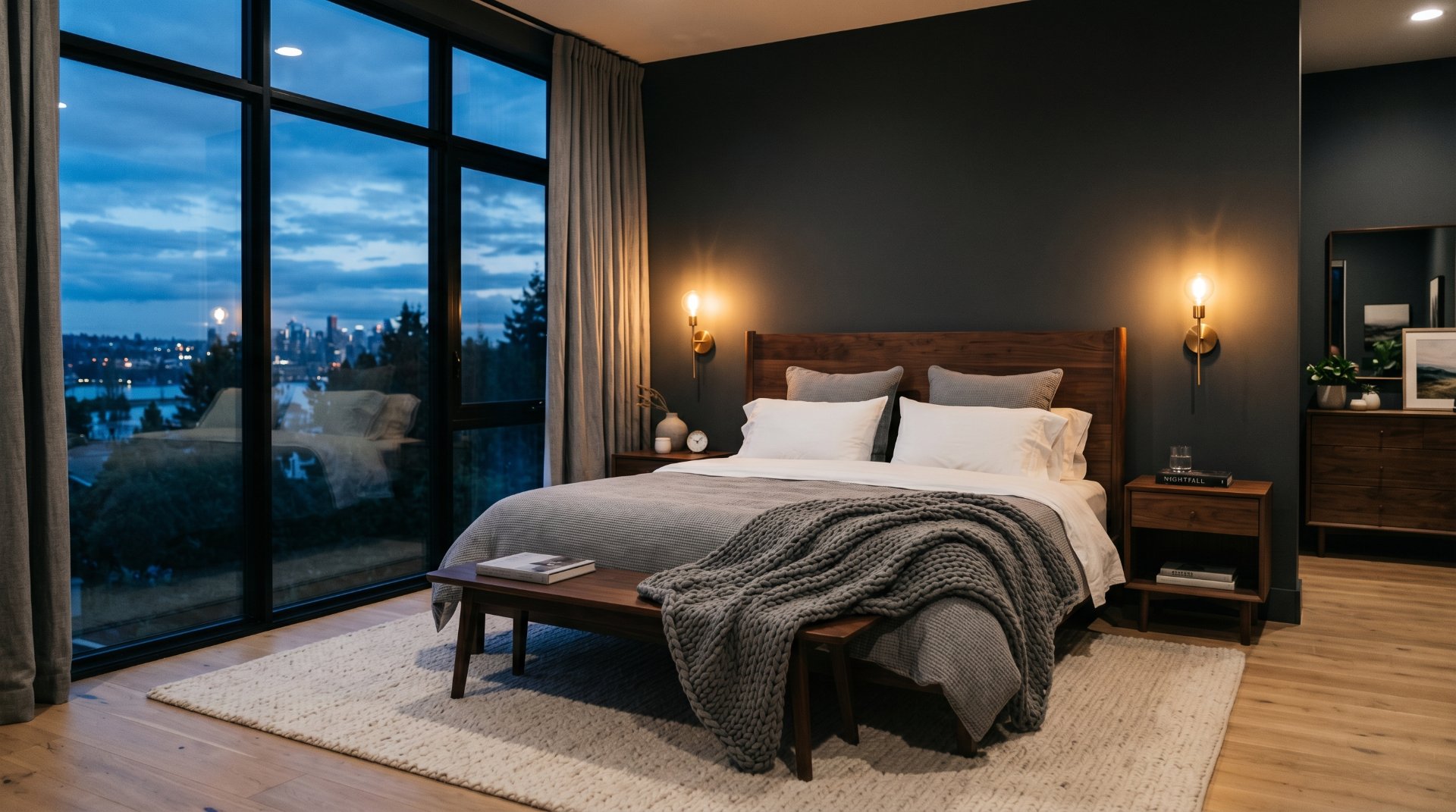
Why Your Dark Bedroom Feels Like a High-End Hotel Every Night
Four months ago, I walked into my guest room and felt nothing. It was painted a safe, predictable “Swiss Coffee” white. By 3:00 PM, the sun hit the walls in a way that felt aggressive rather than warm. I spent $450 on a gallon of deep charcoal paint and two Saturday afternoons transforming it into a moody sanctuary. The result? I stopped sleeping in my master suite. There is a specific kind of gravity in a dark bedroom that pulls you into a deeper state of rest. It isn’t just about a color choice; it’s about a psychological shift. Have you ever noticed how the most expensive boutique hotels in the world favor deep navy or slate? If you are still comparing different palettes before going dark, my full guide to bedroom color combination ideas can help you understand which shades work best for sleep, light, and mood. Why do we settle for hospital-white walls at home when we could live inside a velvet-lined jewelry box? What if the secret to fixing your sleep isn’t a new mattress, but a darker wall? In my experience, once you go dark, every other room starts to feel a bit too loud.
What is the best way to start a dark bedroom design without it feeling like a cave?
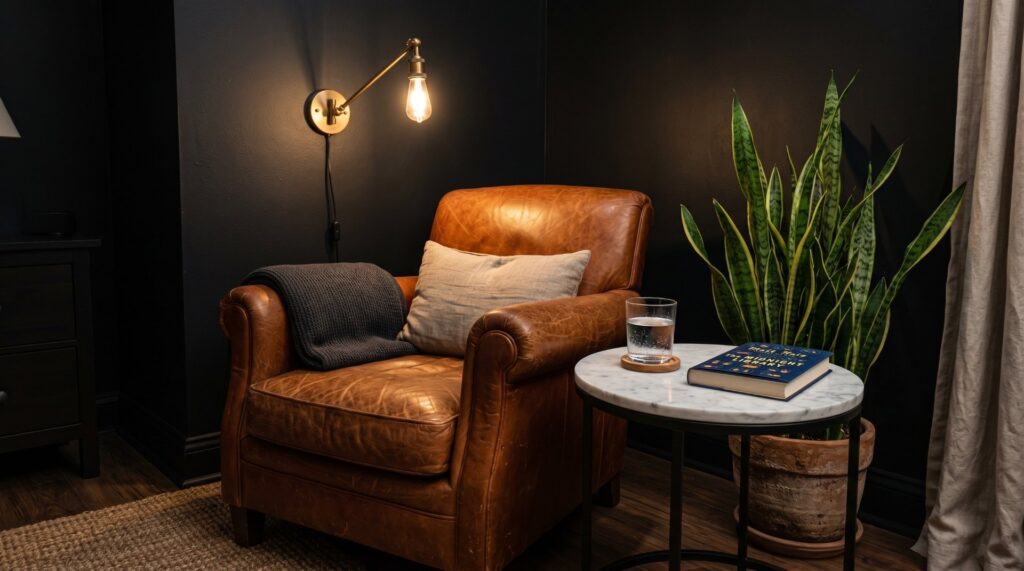
The secret to a successful dark bedroom lies in balanced light sources and varied textures that prevent the walls from absorbing every ounce of energy. You need to layer matte finishes with reflective metals and soft fabrics to create depth. Focus on “warm” darks like charcoal or deep olive rather than flat blacks to keep the space feeling cozy and expensive.
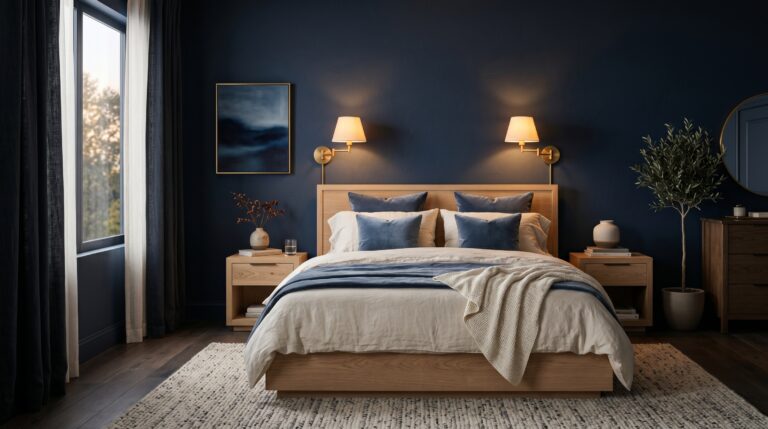
If you want the moodier look to feel soft instead of heavy, these dark cosy bedroom ideas show how to use warm lighting, layered bedding, and texture to make the room feel restful. Three years ago, I helped a friend renovate a small 10×10 space. He wanted a “Men’s Bedroom” vibe but feared it would look like a basement. We used a saturated navy (Benjamin Moore Hale Navy) and paired it with raw brass sconces. The gold tones popped against the dark backdrop, making the room feel intentional. If you just paint the walls and leave your old furniture, it will feel heavy. You have to think about the “pop” factor. In my experience, a dark bedroom needs at least four light sources: two bedside lamps, a ceiling fixture with a dimmer, and a floor lamp.
Most people fail because they use a high-gloss paint. High gloss shows every bump in your drywall and creates a distracting glare. Stick to “Flat” or “Matte” finishes. This allows the color to wrap around you like a blanket. I’ve noticed that when people try to play it safe with a single accent wall, the room feels disjointed. If you are going for a dark bedroom, you have to commit to all four walls. It’s the difference between a deliberate design choice and an unfinished project.
Choosing the right shade for beginners
If you are nervous, start with a Gray Bedroom palette. Gray is the bridge between safety and bold design. If you prefer a softer starting point before going fully dark, a modern neutral bedroom can give you the same clean, restful feeling with less contrast. A deep charcoal like “Iron Ore” provides the mood without the starkness of pure black. I’ve seen this work in dozens of suburban homes where the natural light is inconsistent. It hides imperfections and makes white bedding look crisp and purposeful.
Understanding the role of ceiling color
Should you paint the ceiling dark too? This is the most common question I get. If your ceilings are under eight feet, keep them a soft off-white or a very light gray. If you have high ceilings or crown molding, painting the ceiling the same color as the walls creates a “casket” effect—in a good way. It removes the visual boundaries of the room, making it feel infinite.
1. How do you choose between a Black Bedroom and a Gray Bedroom?
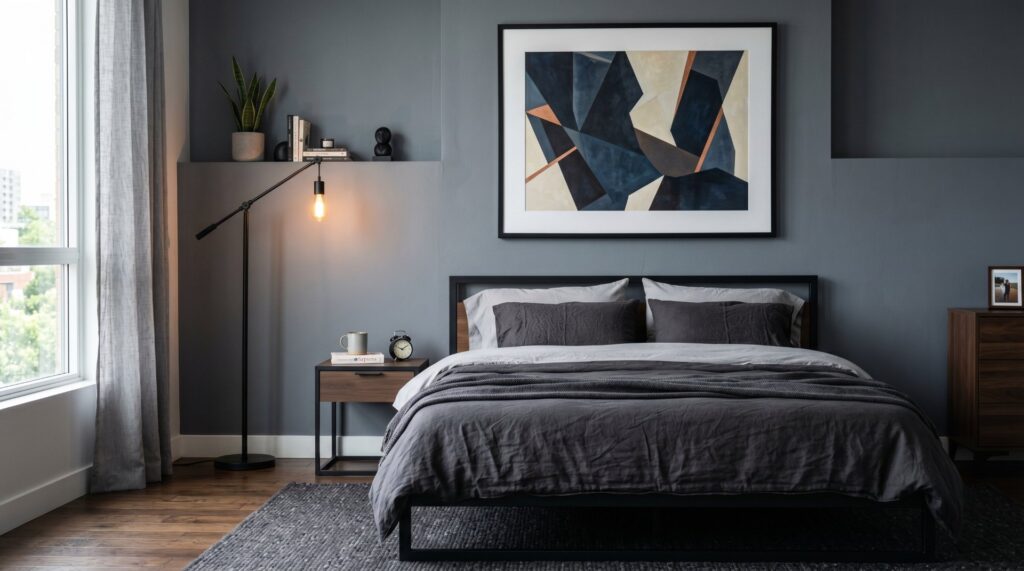
Choosing between black and gray depends on the amount of natural light your room receives and your tolerance for high-contrast design. A black bedroom offers a dramatic, modern edge that works best with minimalist furniture. A gray bedroom provides a softer, more versatile backdrop that accommodates traditional or rustic decor styles while still delivering that moody atmosphere.
Last winter, I worked on two different projects simultaneously. One was a “Dark Home Decor” enthusiast who wanted a pitch-black sanctuary. The other was a couple who wanted a “Mens Bedroom” look but felt intimidated by total darkness. The black room required $1,200 in new lighting because the walls literally ate the light. The gray room was much more forgiving. We kept their existing wood dresser, and it looked like a million bucks against the slate gray.
Here is the truth: Black is a commitment. It requires you to be meticulous with dust (it shows more than you think) and lighting. Gray is a lifestyle. It’s easier to style with different seasonal linens. I’ve tried both, and I find that charcoal gray is the “sweet spot” for most homeowners. It gives you 90% of the vibe with 10% of the stress.
The psychology of black vs. gray
Black represents power and mystery. It shuts the world out. This is great for night-shift workers or people who struggle with insomnia. Gray is more about sophisticated comfort. It feels like a rainy day in a high-end library. Think about how you want to feel at 7:00 AM. If you want to wake up feeling “shielded,” go black. If you want to wake up feeling “calm,” go gray.
2. What lighting works best for a Dark Bedroom?

The best lighting for a dark bedroom involves layering warm-toned bulbs (2700K) at different heights to create pockets of glow. Avoid cool white or daylight bulbs, as they make dark paint look muddy and clinical. Use dimmable LED strips behind headboards or under nightstands to add a modern, floating effect that defines the edges of the room.
I’ll never forget my first attempt at a dark bedroom. I used standard “Daylight” bulbs from a big-box store. The room looked like a haunted garage. It was cold, blue, and depressing. I spent $80 on a set of “Soft White” smart bulbs, and the transformation was instant. Warm light turns a dark room into a sanctuary.
One tool I swear by is the Philips Hue system. It’s pricey (around $150 for a starter kit), but being able to dim your lights to 10% at night changes the way the paint looks. In my experience, a dark bedroom is actually at its most beautiful when the lights are low. You see the texture of the walls without the harsh shadows. I’ve noticed that “Mens Bedroom” designs often overlook the importance of a statement pendant light. A large, oversized paper lantern or a brass Sputnik chandelier breaks up the darkness and gives the eye a place to rest.
Strategic placement of sconces
Wall-mounted sconces are a game-changer. They free up space on your nightstand and allow you to direct light exactly where you need it. If you are renting, look for “plug-in” sconces. Brand like West Elm or even IKEA have great options that don’t require a horizontal rule to install.
3. Which textures make Dark Home Decor feel cozy instead of cold?

To make dark home decor feel cozy, you must layer high-contrast textures like chunky wool knits, velvet pillows, and natural wood grains. These materials break up the flat surface of dark walls and add tactile warmth. A mix of matte and sheen—such as a silk rug against a flat-painted wall—creates the luxury hotel aesthetic everyone craves.
Last October, I visited a showroom in New York that was entirely dark. What stood out wasn’t the color, but the layers. There was a leather chair, a faux-fur throw, and linen curtains. For a more playful version of moody design, a dark whimsical bedroom can add vintage art, patterned bedding, and magical details without losing the cozy feeling. In my experience, if you have dark walls and flat cotton sheets, the room feels “thin.” You need weight. I’ve tried adding a heavy velvet curtain in a slightly different shade than the wall (think charcoal walls with navy curtains), and it adds incredible depth.
Most people overlook the floor. If you have dark walls, a light-colored rug is mandatory. A cream or light-gray jute rug provides a “ground” for the room, preventing it from feeling like a bottomless pit. I’ve seen this work wonders in “Mens Bedroom” setups where the furniture is often dark wood or black metal. The rug acts as a visual anchor.
The “rule of three” for pillows
When styling a bed in a dark room, use three different textures. For example: linen base shams, a velvet accent pillow, and a knitted throw. This variety creates a visual landscape that keeps the room from looking like a flat photograph.
4. How do you style furniture in a Men’s Bedroom with dark walls?
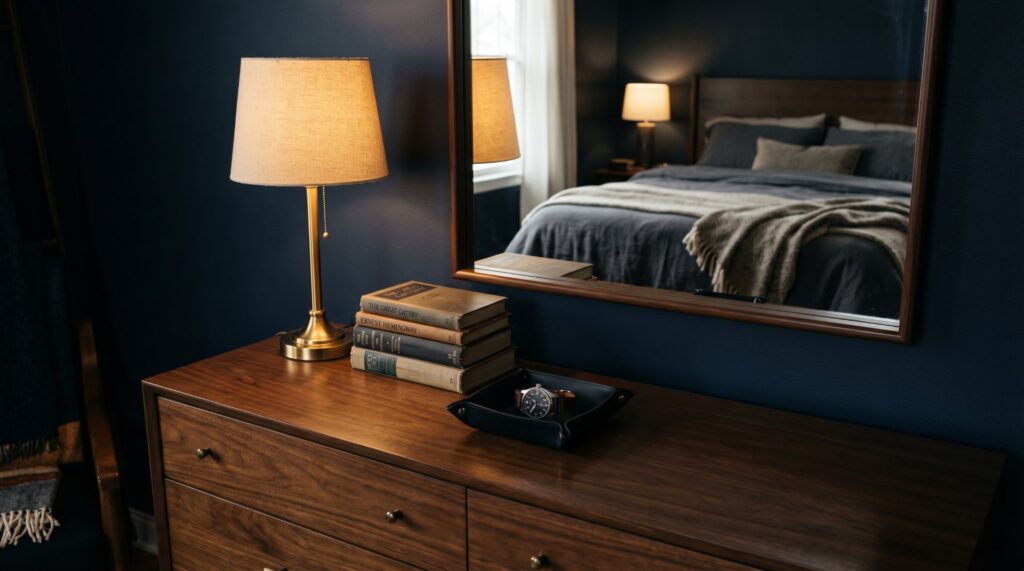
In a mens bedroom with dark walls, furniture should feature clean lines and contrasting materials like cognac leather, walnut wood, or brushed steel. Avoid bulky, oversized furniture that crowds the space. Instead, opt for “floating” nightstands or slim-profile bed frames that allow the dark wall color to flow uninterrupted behind the pieces.
I once worked with a client who had a massive, traditional oak bedroom set. He wanted to paint the room black. We did it, and the furniture looked like it was from a 1980s office. We ended up swapping the heavy dresser for a mid-century modern walnut piece, and the difference was staggering. The warm orange tones of the walnut popped against the cool dark walls.
If you are on a budget, change the hardware. Brass or gold handles on a dark dresser look incredibly high-end. I’ve seen $50 IKEA dressers look like $1,000 designer pieces just by putting them against a dark wall and changing the knobs. This is a “behind the curtain” secret that interior designers use all the time.
| Furniture Item | Recommended Material | Why it Works |
| Bed Frame | Upholstered Gray or Tan | Softens the hard lines of the walls. |
| Nightstand | Walnut or Oak Wood | Adds organic warmth to the cool palette. |
| Accent Chair | Cognac Leather | Creates a masculine, timeless focal point. |
| Lamps | Antique Brass | Adds a much-needed metallic “glow.” |
| Curtains | Heavy Linen | Provides texture without looking too formal. |
5. Can a small room handle a Dark Bedroom theme?
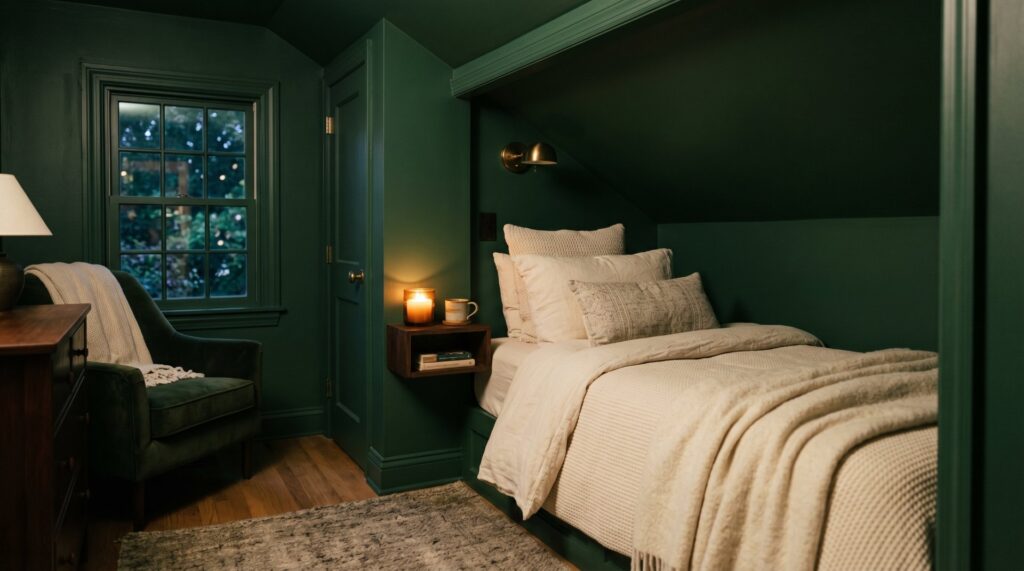
Yes, a small room can handle a dark theme because dark colors blur the corners and edges of the walls, creating an illusion of infinite space. Contrary to popular belief, white walls can make a small room feel boxed-in by highlighting the narrow dimensions. A dark bedroom feels like a cozy cocoon, which is ideal for smaller floor plans.
Three months ago, I helped a neighbor with a tiny 9×9 nursery-turned-office. We painted it a deep forest green (nearly black). Before, you could feel exactly how small the room was. After, the walls seemed to recede. It’s a classic “pattern interrupt”—people expect a small room to be white, so when it’s dark, it feels curated and intentional.
The key here is “tonal” decorating. Paint the baseboards, the doors, and the window trim the same color as the walls. This removes all the “breaks” in the room, making it look much larger than it is. I’ve noticed that when people leave white trim in a small dark room, it creates a “striped” effect that actually makes the room feel shorter.
6. What are common mistakes when implementing Dark Home Decor?
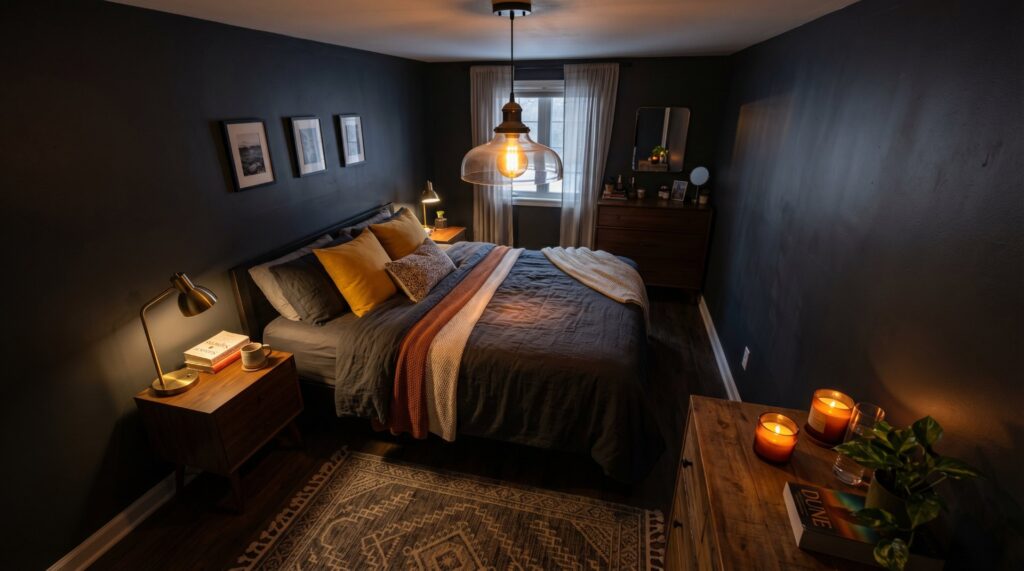
The most common mistake in dark home decor is neglecting the “fifth wall” (the ceiling) and failing to provide enough contrast through accessories. Many homeowners also forget to account for how the paint color changes throughout the day, leading to a room that looks great at noon but muddy at 8:00 PM. Always test large swatches before committing.
Here is what nobody tells you: Dark paint is a magnet for dust and fingerprints. If you have kids or pets, a flat black wall is going to show every single touch. I wish I’d known this before I painted my hallway charcoal. Use a “Scuff-X” or “Washable Matte” paint line from a reputable brand like Benjamin Moore or Sherwin Williams. It costs about $30 more per gallon, but it will save your sanity.
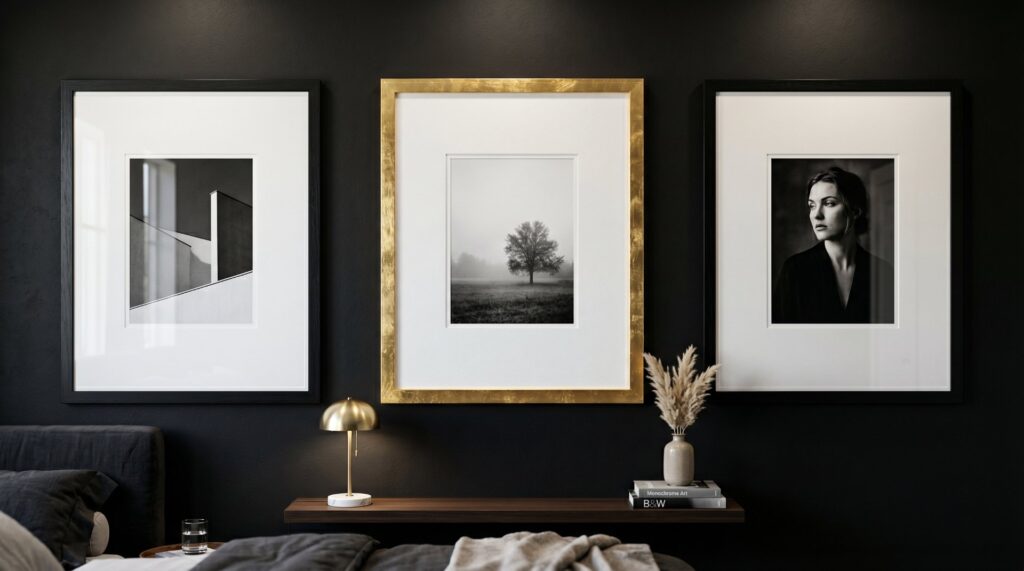
Another mistake is “under-decorating.” A dark room needs more art than a light room. Because the background is so heavy, a single small picture will look lost. You need large-scale art with wide white matting. The white matting provides a visual “breath” against the dark wall. I’ve tried using small frames in a dark room, and it just looks cluttered. Go big or go home.
The “Swatches” failure
Never pick a dark color from a 2-inch paper square. Go to the store and get a sample jar. Paint a 3-foot square on every wall of the room. Look at it in the morning, at noon, and with your lamps on at night. Some grays turn purple. Some blacks turn green. You don’t want to find that out after you’ve bought five gallons.
7. How do you balance a Gray Bedroom with natural elements?
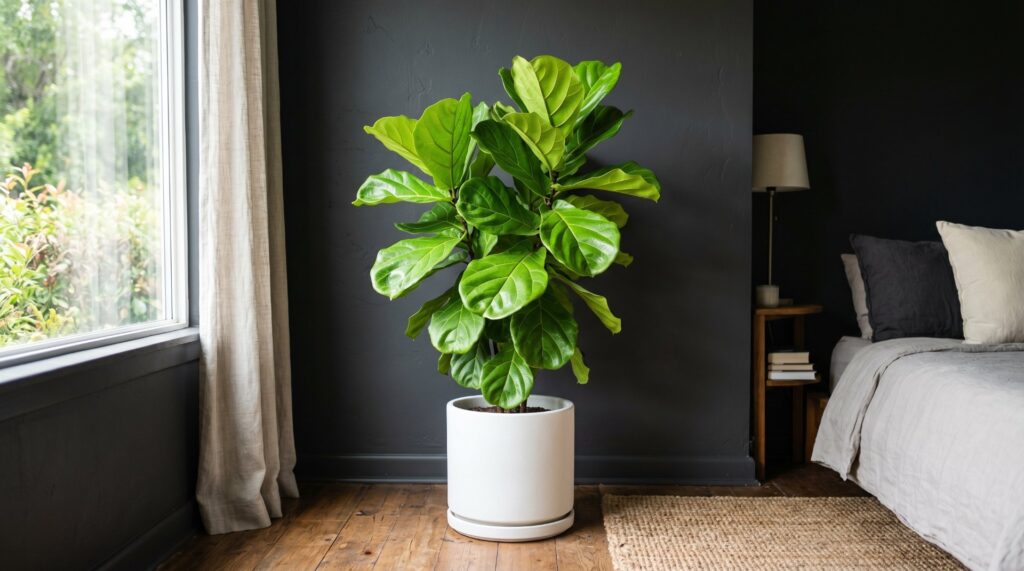
Balancing a gray bedroom requires the introduction of “life” through indoor plants, natural wood, and stone. Plants like the Fiddle Leaf Fig or Snake Plant thrive visually against a gray backdrop, as the green foliage becomes incredibly vibrant. Using raw wood elements, like a reclaimed timber headboard, offsets the industrial feel of gray paint.
I’ve noticed that the most successful “Gray Bedroom” designs on Pinterest all have one thing in common: a touch of green. I’ve tried adding a tall potted plant in the corner of a slate-colored room, and it instantly felt “expensive.” The organic shapes of the leaves break up the straight lines of the walls.
For a “Mens Bedroom” vibe, look into stone accessories. A marble tray on the nightstand or a concrete lamp base adds a layer of sophistication. I once saw a room that used a large piece of driftwood as art above a gray bed. It was simple, free, and looked like something out of a high-end gallery.
8. What is the ROI of a Dark Bedroom renovation?

The ROI of a dark bedroom renovation isn’t just financial; it’s measured in sleep quality and aesthetic satisfaction. While a bold paint choice may require a “neutralizing” coat before selling a home (costing roughly $500), the immediate impact on the home’s “wow factor” during showings can lead to faster offers. Most buyers view a well-executed dark room as a high-end designer touch.
Last year, a local realtor told me that “moody rooms” are the new “granite countertops.” People are tired of the all-white farmhouse look. They want rooms that feel like a destination. A dark bedroom feels like a luxury. If you spend $1,000 on paint, lighting, and new bedding, you can easily add $5,000 in perceived value to your home.
In my experience, buyers remember the “Black Bedroom” house. They might say, “the one with the cool dark room.” It makes your home stand out in a sea of beige. However, if you do it poorly—messy paint lines, cheap lighting—it will have the opposite effect. Excellence is the only way to get a return on this specific trend.
9. How to transition your current room into a Dark Bedroom?
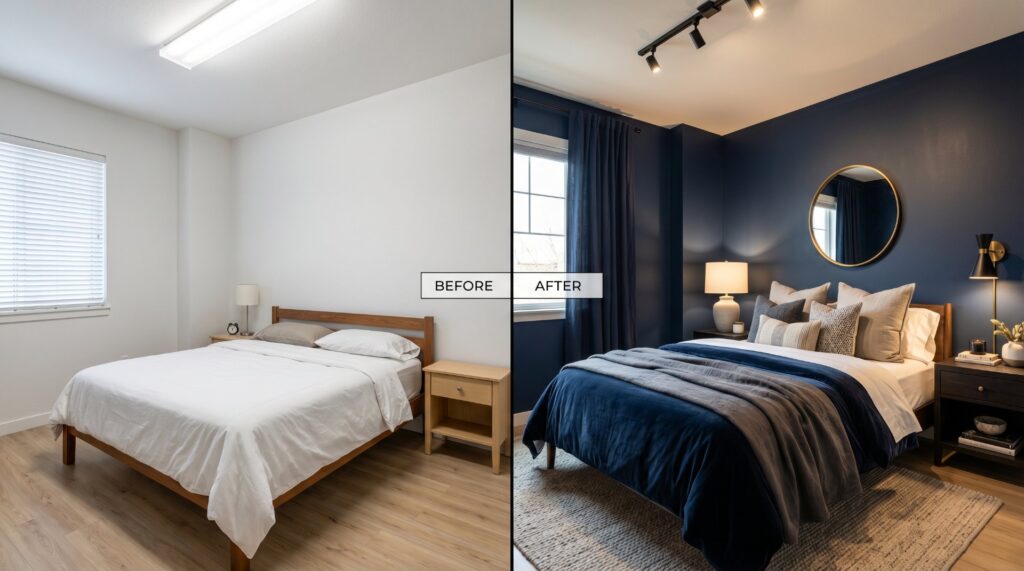
Transitioning to a dark bedroom starts with the “Big Three”: Paint, Bedding, and Lighting. Start by swapping your current bedding for something light and textured to prepare for the dark walls. Next, install your new lighting fixtures so you can see the paint color accurately. Finally, paint the walls, starting with the wall behind the bed to get a feel for the depth.
I always tell people to start with the bedding. If you have a dark duvet and you paint your walls dark, the room will feel like a black hole. Buy a high-quality white or light-cream duvet first. Once that is on the bed, the dark walls will have something to contrast against. It’s a “behind the curtain” trick that makes the process feel less overwhelming.
I’ve tried doing it the other way—painting first—and it’s terrifying. You sit in a dark room with your old colorful bedding and think, “I’ve made a huge mistake.” By changing the bedding first, you create the “landing spot” for the design.
Step-by-Step Transition
- Clear the decks: Remove everything from the walls and surfaces.
- Light check: Replace old bulbs with 2700K warm LEDs.
- The Test: Paint your 3×3 swatches and wait 24 hours.
- The Deep Dive: Paint the walls, including the trim for a seamless look.
- The Layering: Add your light rug, wood furniture, and brass accents.
10. What are the best color pairings for a Black Bedroom?
The best color pairings for a black bedroom are cognac, sage green, and muted gold. These colors offer enough warmth to counteract the coolness of the black without being as jarring as a pure white. For a more modern approach, pairing black with deep burgundy or forest green creates a “tone-on-tone” luxury that is incredibly popular in European design. You can also explore these burgundy bedroom ideas if you want a warmer, richer alternative to black or charcoal walls.
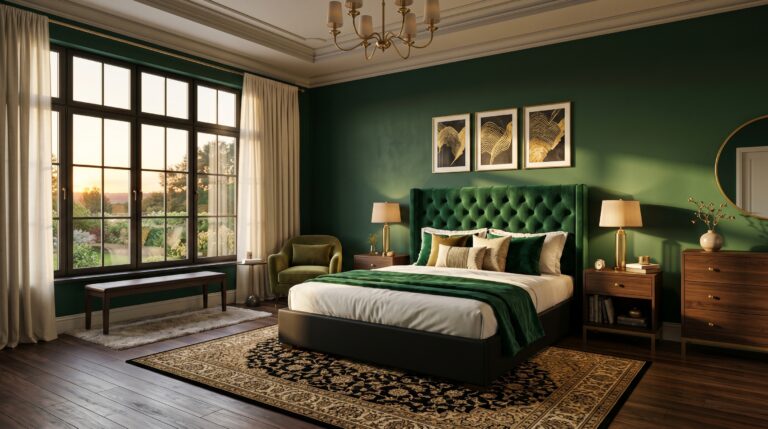
I once stayed in a hotel in London that paired black walls with a deep emerald velvet headboard. It was the most sophisticated room I’ve ever seen. If you love that luxury hotel feeling, an emerald green black and gold bedroom is one of the strongest ways to make a dark room feel rich instead of flat. Since then, I’ve tried to replicate that “jewel tone” look in my own projects. It’s less “goth” and more “royalty.”
If you are going for a “Mens Bedroom” look, stick to the “Black and Tan” rule. Use black for the walls and tan/leather for the furniture and accessories. It’s a classic combination that never goes out of style. I’ve noticed that when people try to use bright “pop” colors like red or yellow against black, it starts to look like a fast-food restaurant. Keep your accent colors muted.
FAQ
Is a dark bedroom a bad idea for a room with no windows?
Actually, it’s the best idea. If a room has no natural light, trying to paint it white will just make it look like a dingy, shadowy gray. By leaning into the darkness and painting it a deep color, you acknowledge the lack of light and turn it into a cozy, intentional cave. Just make sure your artificial lighting is top-tier.
Will a dark bedroom make me feel depressed?
Color psychology suggests that dark blues and grays are actually very grounding and can lower heart rates. However, if you are prone to Seasonal Affective Disorder, ensure you have plenty of warm “mood” lighting to mimic a cozy fire. It’s about creating a “womb” feel, not a “tomb” feel.
What color should my curtains be in a dark room?
If you want the room to feel larger, match the curtains to the wall color. This creates a continuous line. If you want more drama, choose a fabric one or two shades lighter or darker than the wall. Always hang them high and wide to make the window feel larger than it is.
Do I need to use special primer for dark paint?
Yes. Always use a gray-tinted primer when going from light to dark. If you use a standard white primer, you will end up needing four or five coats of expensive dark paint to cover it. A gray primer allows the dark pigments to settle in two coats.
Can I have a dark bedroom if I have dark wood floors?
Yes, but you must use a light-colored rug to separate the two. Without a rug, the furniture, floor, and walls will all bleed together into a dark mass. A cream or light-gray rug provides the necessary visual “buffer.”
How do I clean dark walls without leaving streaks?
Dark matte paint is notoriously difficult to clean. Use a damp microfiber cloth with just a drop of dish soap. Never use aggressive chemicals or scrub too hard, as this will create “burnishing”—shiny spots where the matte finish has been rubbed away.
What kind of art looks best on black walls?
Art with a lot of “negative space” or white backgrounds. Photography with white matting or gold-leaf frames looks incredible. The dark wall acts as a gallery backdrop, making whatever you hang on it look twice as expensive.
Is charcoal better than navy for a moody room?
Charcoal is more neutral and works with almost any furniture. Navy is more of a “statement” and can sometimes feel a bit “nautical” if not styled correctly. If you want versatility, go charcoal. If you want a specific “mood,” go navy.
Should I paint my radiator or heater the same dark color?
Yes! Unless your radiator is a beautiful antique brass or copper, paint it. Making it disappear into the wall color is a classic high-end design move that makes the room look much more polished and custom.
Can I use dark wallpaper instead of paint?
Absolutely. A textured grass cloth wallpaper in a dark charcoal adds even more “cozy” vibes than paint. It also helps with sound dampening, which is great for a bedroom. It is more expensive and harder to install, but the result is stunning.
Does dark furniture work in a dark room?
It can, but you need to be a master of texture. A black metal bed against a black wall works if you have light bedding and wood nightstands. If everything is the same shade of dark, you lose the “shape” of the room.
How do I handle the transition from a light hallway to a dark bedroom?
Keep the door closed if it bothers you, or choose a “transitional” color for the hallway that is a medium-gray. Personally, I like the “portal” effect—walking from a bright hallway into a dark, quiet sanctuary creates a physical sensation of relaxation.
Moving Forward With Your Dark Sanctuary
Designing a dark bedroom is an act of bravery in a world obsessed with “bright and airy.” It is a choice to prioritize your rest and your personal aesthetic over what is “safe.” Last Tuesday, I sat in my charcoal-walled guest room as the sun went down, and I watched the shadows play across the velvet pillows. It felt like a hug. My prediction? We are going to see a massive shift away from the “all-white” aesthetic over the next two years. People are craving depth and soul in their homes. Start with one wall if you must, but don’t be surprised when you end up painting the whole room by the weekend. What is the one thing stopping you from picking up that charcoal paint brush today?

2 Comments